
Why it hits harder than the structure suggests
The assumption underneath every bereavement policy is that closeness follows blood. For a great many adults that is simply inaccurate.
A close friend is frequently the person who knew the most current version of you. Family often knows who you were at nineteen. A friend knows what happened last Tuesday, what you are actually worried about, and the things you have never said to a relative. For people estranged from family, or living far from them, or whose family relationships are difficult, a friend may be the primary attachment in their life.
Friendship is also unusually chosen and unusually ordinary. It survives on repeated small contact rather than on obligation, which means the loss is felt in a hundred small places: the message you go to send, the standing Thursday, the person you would have told first. Losing that is not a lesser category of loss. It is simply one with no paperwork.
What makes it isolating
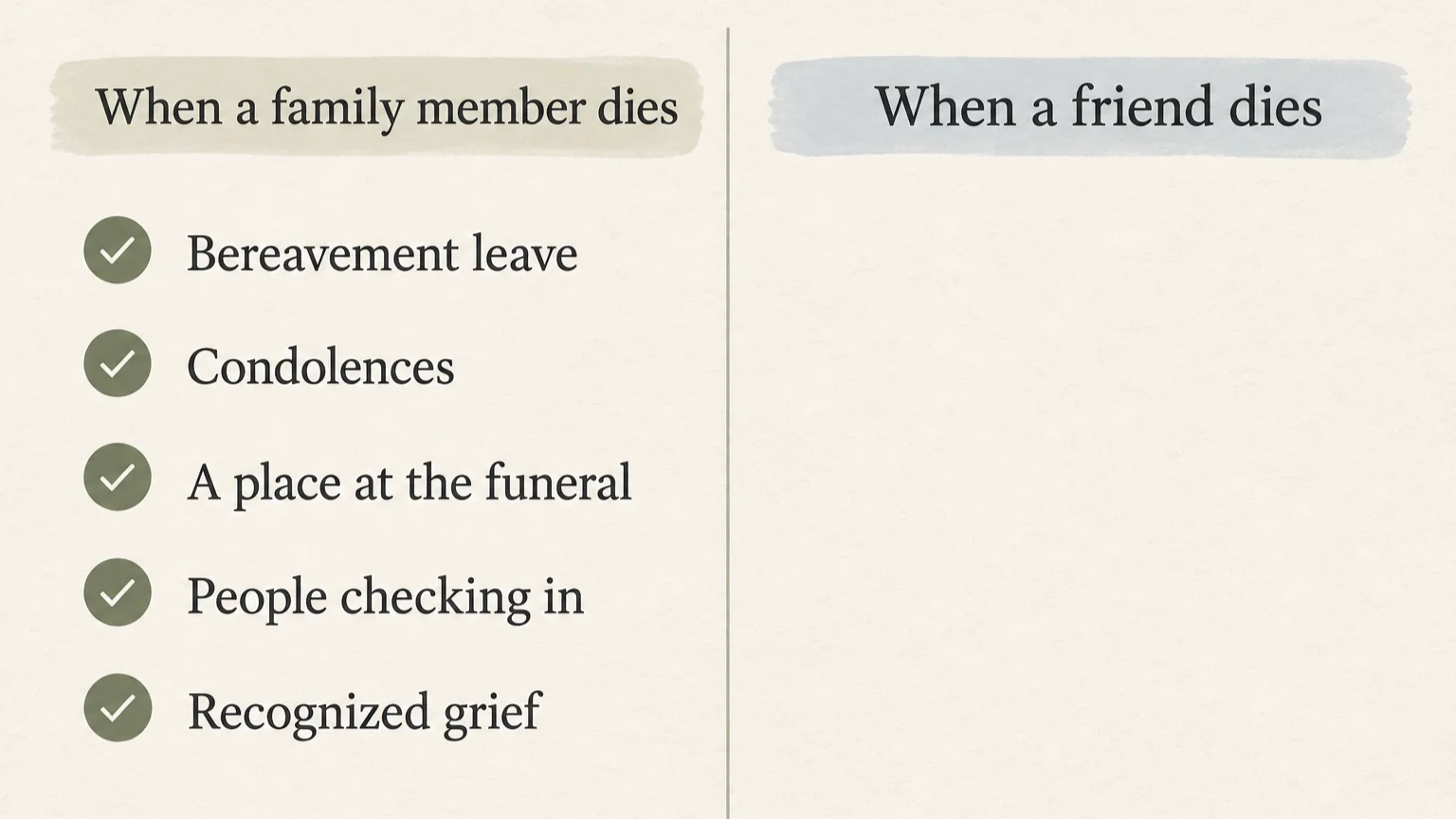
- No leave. Almost no bereavement policy covers a friend. You are back at work while it is still the only thing you can think about, and if you take time you have to characterize it as something else.
- No standing at the funeral. You sit further back than your grief warrants. You may not be told about arrangements at all if you were not known to the family. Some people learn of the death through social media.
- Condolences flow past you. People offer sympathy to the family, and you are frequently the one offering it, while carrying your own loss unremarked.
- Nobody checks in later. The family gets calls at month three. You do not, because nobody registered you as bereaved in the first place.
- You may be the one holding the friend group together. Frequently the case, and it means grieving while organizing, which delays your own.
- Comparison creeps in. People minimize their own grief because someone else lost a spouse or a child. Grief is not a ranked competition and it is not zero-sum. Someone else losing a spouse does not make your loss smaller, and the instinct to rank it is usually a way of pre-empting the ranking you expect other people to do.
This is the shape we describe in our post on disenfranchised grief: a real loss with no social apparatus attached to it.
When you had drifted
Someone you were once inseparable from and had not seen in three years. The grief frequently arrives with unexpected force plus a layer of guilt about the drift, and a strong sense of having no right to it. You do. What you are grieving includes the friendship as it was and the reconciliation that is now impossible.
When you are also supporting the family
Close friends are often drafted, willingly, into helping the spouse or the parents. It is meaningful work and it can defer your own grief indefinitely because there is always something else to do. Watch for the point at which you are the only one still holding everyone.
When they were young
For many adults the first significant bereavement is a friend rather than a grandparent, and it arrives with a mortality reckoning attached. The death of a peer removes an assumption you did not know you were relying on.
When it was a colleague
Workplace deaths produce a peculiar grief: people you spend forty hours a week with, an empty desk, and a professional register that does not permit much. The awkwardness is usually people not knowing what is permitted rather than not caring.
When the death was sudden or by suicide
Both add layers. Our posts on sudden death and traumatic grief and on grief after a suicide cover those dimensions, and both apply regardless of whether you were family.
What helps
- Say it plainly. "My best friend died" rather than "a friend of mine died.” The qualifier is a habit of minimizing and it invites everyone else to minimize it too.
- Ask for the time anyway. Many managers will grant leave that policy does not require if asked directly. Framing it as a bereavement rather than as needing a personal day is usually the better approach.
- Make your own ritual. You may not be included in the family’s, and you can hold your own. A gathering of the friend group, a walk you always did, a date marked deliberately.
- Keep the friend group together on purpose. These groups scatter after a death, which produces a second loss on top of the first. Someone has to send the message, and it may as well be you.
- Talk to people who knew them. The most useful thing available, and one of the few places you can say their name without explaining who they were.
- Give the body somewhere to put it. Grief with no social outlet tends to settle physically. Our sister practice, the Center for Mind Body Balance , works on exactly that in the same building.
- Take the grief to a group if it has nowhere to go. Bereavement groups do not require you to be family. Our post on what a grief support group is actually like describes the format.
If you are supporting someone whose friend died
Two things, both simple. Treat it as a real bereavement, using the same words and the same seriousness you would for a family death. And check in at month three, when everyone else has stopped and nobody ever started with them. Our post on what to say to someone who is grieving applies here in full.
The American Psychological Association has a general overview of bereavement worth reading, though as with most of the literature it assumes a family loss, which is precisely the gap this post exists to name. For younger adults facing a first bereavement, The Dougy Center publishes guidance that is useful well beyond the age range it is written for.
Frequently Asked Questions
Is it normal to be more affected than the family?
Yes, and it happens frequently, particularly where you saw them more often or knew a side of them the family did not. Grief tracks the actual relationship rather than the formal one.
I was not invited to the funeral. What do I do?
It is usually an oversight rather than a message, since families in acute grief work from whatever list they have. Hold your own marking of it, and if you want contact with the family, a letter about who your friend was to you is almost always welcomed, frequently more than you expect.
How do I explain to my employer why I am struggling?
Plainly, and without downgrading it. "My closest friend died and I am finding it harder than I expected" is accurate and sufficient. Our post on going back to work while grieving covers the conversation in more detail.
Start with a conversation
If you have been carrying this on your own because nobody registered you as someone who lost anyone, that is exactly the situation this call is for.
Fifteen minutes, no charge, no obligation. You do not have to justify the relationship or explain why it counts. Nobody here will ask whether you were family.
Call (201) 708-8448 or book a free 15 minute call. We see clients in Saddle River and across New Jersey by video and in person.
This blog post is for informational purposes only and does not constitute professional mental health advice, diagnosis, or treatment.