
Why people say nothing
The reason is almost never indifference. It is fear of making it worse: of reminding them, of saying something clumsy, of causing tears in a supermarket aisle.
Two things about that. The first is that you cannot remind someone their person died. It is the only thing they are thinking about. There is no version of the conversation in which you introduce the subject to them.
The second is that this fear produces the outcome bereaved people describe as the most painful part of the whole experience. Not the funeral, not the paperwork. The friends who stopped calling. People consistently report that the clumsiest attempt at comfort was easier to bear than a person crossing the street to avoid the conversation, and they remember who did which for years.
So the standard is not getting it right. The standard is saying something.
What to say
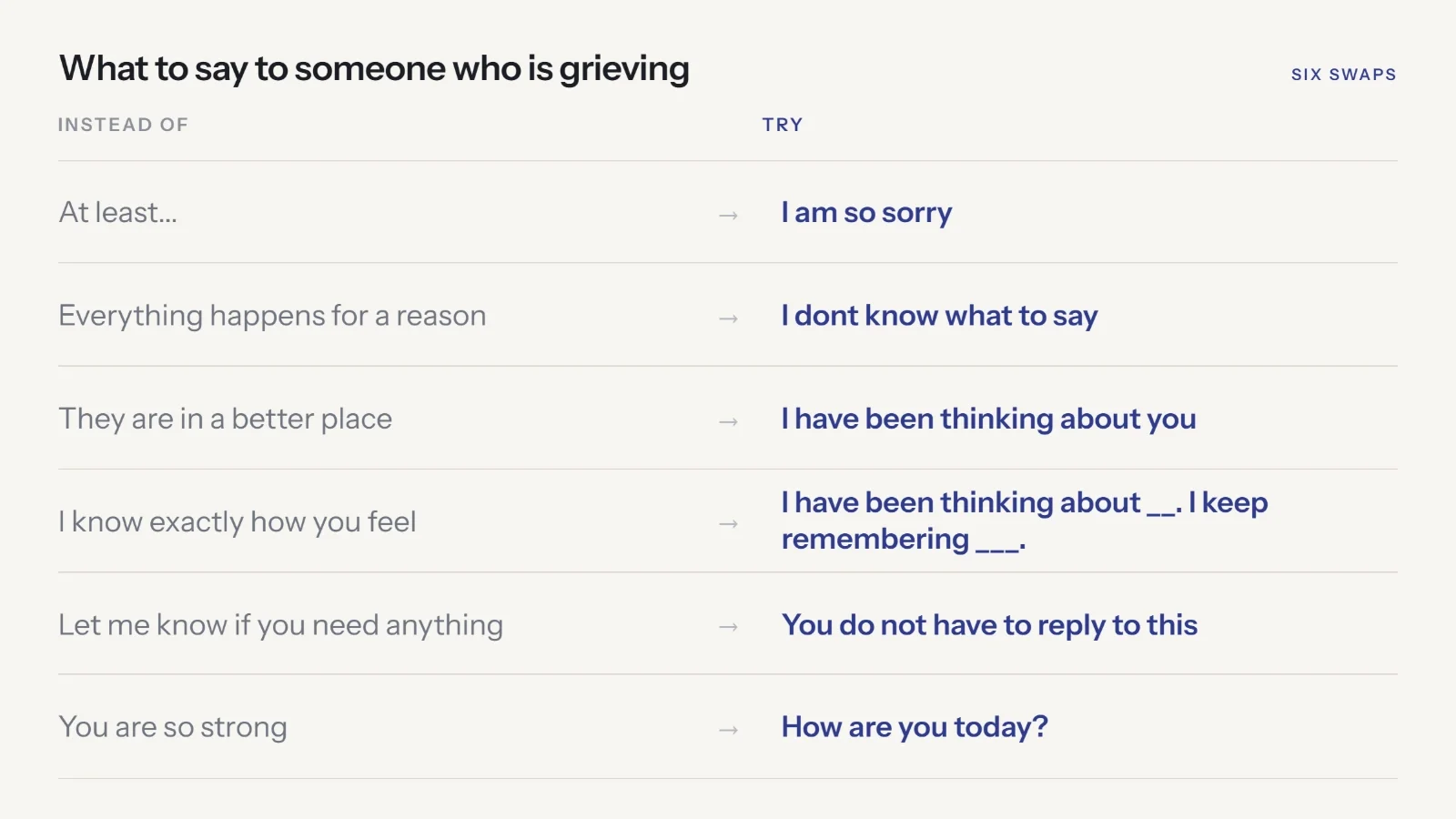
Short, specific, and not attempting to fix anything.
- "I am so sorry." Complete on its own. It does not need a follow-on clause and is stronger without one.
- "I do not know what to say." Honest, and almost universally received well. It signals that you understand the size of it rather than reaching for a formula.
- "I have been thinking about you." Works at any distance from the death and requires no reply.
- "I have been thinking about David. I keep remembering the way he ordered coffee." The single most valuable thing you can offer. Say the person’s name and give a specific memory. Bereaved people are frequently starved of hearing their person mentioned, and a memory you hold is one they did not have.
- "You do not have to reply to this." Removes the obligation from a message, which matters because the volume of correspondence in the first weeks is genuinely overwhelming.
- "How are you today?" Better than "how are you", because it asks something answerable rather than something enormous.
- "Would it help to talk, or would it help to think about something else? Either is fine." Gives them a choice rather than requiring them to manage your expectations.
What all of these have in common is that none of them asks the grieving person to do anything, reassure anyone, or produce a response that makes the speaker feel better.
What to stop saying
These are said with genuine kindness. They land badly for reasons that are worth understanding rather than just memorizing.
- "At least..." Anything after those two words is an argument that the loss was smaller than it is. At least they lived a long life. At least it was quick. At least you can have another. Delete the construction entirely.
- "Everything happens for a reason." Asks the bereaved person to accept that their loss served a purpose, which is a great deal to require of someone in month one.
- "They are in a better place." Only works if you know for certain the person shares that belief, and it frequently lands as a correction of their grief.
- "I know exactly how you feel." You do not, even if you have lost someone. It shifts the conversation toward your loss. "I lost my mother two years ago, so I have some idea, though yours is your own" does the same work without taking the ground.
- "Let me know if you need anything." Well meant and almost never acted on, because it puts the work of identifying a need and asking for it onto someone with no capacity for either. See the next section.
- "You are so strong." Frequently read as an instruction to keep performing competence, which is exhausting and is one of the reasons people stop being honest about how they are.
- "Are you feeling better?" Grief is not an illness with a recovery. The question implies a schedule they are being measured against.
- Anything about timing. It has been six months. It has been a year. Nobody wants to hear a countdown of their own grief.
What to do, which matters more than what you say
The words are the smaller part of this. What people actually remember is who showed up and who kept showing up.
- Make the offer specific. Not "let me know if you need anything" but "I am at the shop, I am getting you milk and bread, is there anything else". Not "we should get lunch sometime" but "I am free Thursday, I will come to you". A specific offer can be accepted with one word. A general one requires a project.
- Do the practical thing without asking. Mow the lawn. Take the bins out. Handle the school run. Bring food that does not require a dish to be returned, because returning dishes is an obligation.
- Turn up and do not stay long. Twenty minutes on the doorstep with coffee is often better than an evening that has to be hosted.
- Come back in three months. This is the highest-value thing on the list. Support is intense for about six weeks and then stops almost entirely, at exactly the point the numbness lifts and the loss lands properly. A message at month four, when nobody else is sending one, is worth more than everything you did in week one. We wrote about why in our post on why the second year is often harder .
- Put the dates in your calendar. The birthday, the anniversary of the death. A message on those days, from someone who did not have to be reminded, is remembered for years.
- Keep inviting them. They may decline everything for a long time. Being asked is the point. Being dropped from the list because you assumed they would say no is a second loss.
When the loss is not socially recognized
Pet loss, miscarriage, estrangement, divorce, the death of an ex-partner, a friend rather than family. These carry the additional weight of not being treated as real losses, which we cover in our post on disenfranchised grief. The most useful thing you can do is treat it exactly as you would a death the world recognizes. Say sorry, use the name, do not qualify it.
When the death was a suicide
Say the person’s name and offer condolences the way you would for any death. Do not ask how it happened, do not speculate about why, and do not fall silent, which is what most people do and what compounds an already isolating loss.
When the relationship was complicated
If they were estranged, or the person who died hurt them, avoid both "you must be devastated" and "at least you are free of that." Complicated grief is frequently harder rather than easier. "I imagine that is complicated" is a good sentence, and then let them tell you.
When it is a colleague
Say something on their first day back, briefly, and then treat them normally. The two failure modes are ignoring it entirely and being so careful around them that they feel marked. Our post on going back to work while grieving is written for them, and is worth reading if you manage someone in this position.
Frequently Asked Questions
It has been months and I never said anything. Is it too late?
No, and a late message is frequently more valuable than an early one, because almost nobody sends them. "I have been meaning to write for months and did not know what to say. I am sorry. I have been thinking about you both" is enough. Do not spend the message apologizing for the delay.
What if I make them cry?
You will not have caused it. Grief is already there and being able to release it with someone who is not flinching is generally a relief rather than a harm. Sit with it, do not apologize, do not rush to change the subject.
How do I know if they need professional support rather than friends?
Both, usually. If it has been more than a year and things are getting harder rather than easier, if they cannot function, or if they have withdrawn completely, that is worth gently raising. You can send them something rather than making a speech. If you are worried about their immediate safety, the 988 Suicide and Crisis Lifeline is available by call or text at any hour.
Where to read further
The American Psychological Association has a plain overview of bereavement worth reading if you are supporting someone long-term, and The Compassionate Friends runs chapters across New Jersey for families who have lost a child. If what you are carrying alongside this is your own grief, which is common when the loss touches you too, our sister practice the Center for Mind Body Balance shares the building with us.
Start with a conversation

If you are supporting someone and are out of your depth, that is a reasonable thing to call about. People do, more often than you might expect.
Fifteen minutes, no charge, no obligation. We will talk through the situation and what might actually help, whether that is something you do or something they might want to consider.
Call (201) 708-8448 or book a free 15 minute call. We see clients in Saddle River and across New Jersey by video and in person.
This blog post is for informational purposes only and does not constitute professional mental health advice, diagnosis, or treatment.