
Two things happening at once
An expected death, after a long illness, allows the mind to begin adjusting in advance. That is genuinely difficult in its own way, which we cover in our post on anticipatory grief. But it means that when the death occurs, the nervous system has had some preparation.
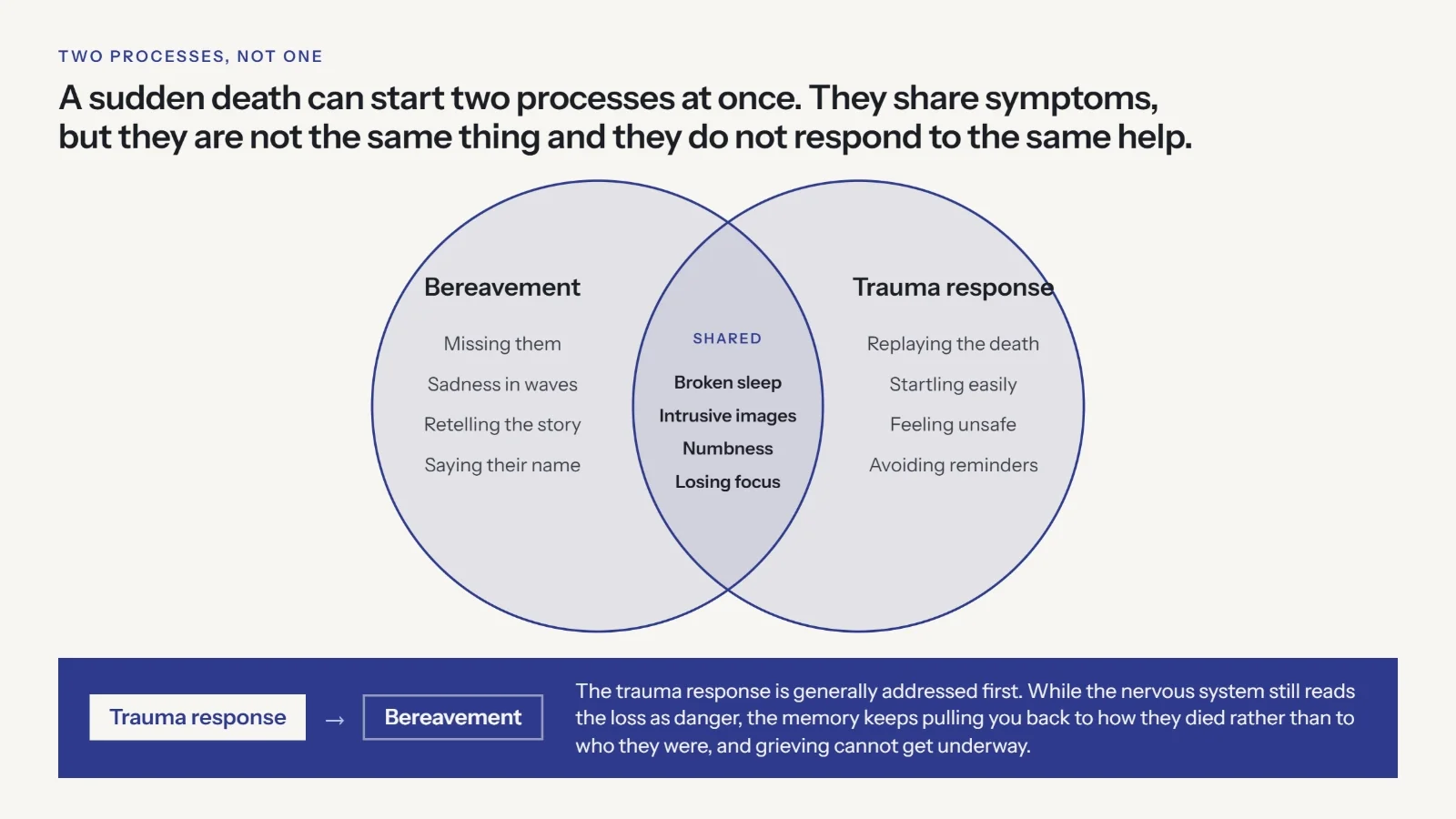
A sudden death allows none. The information arrives in a single moment, and it is more than the system can process at the speed it arrives. What follows is not only bereavement. It is bereavement plus a trauma response, and the trauma response has its own characteristic features.
- Intrusive images. The moment of being told, or of finding them, returning unbidden and vividly. Frequently at night, frequently triggered by something apparently unrelated.
- Replaying. Going over the sequence again and again, looking for the point at which it could have gone differently. This is the mind attempting to process something it could not process in real time.
- Hypervigilance. A phone ringing at an unusual hour producing a full physical alarm response. Sustained anxiety about other people’s safety that is disproportionate and difficult to argue with.
- Disbelief that outlasts the funeral. Continuing to expect them, months on, at a level that feels unreasonable but does not shift.
- Numbness that concerns you. Many people describe feeling nothing for weeks and worrying about what that says about them. It is protective, it is common, and it lifts.
These are trauma responses rather than grief responses, and the distinction is not academic. It determines what helps.
Why grief work sometimes stalls
A person arrives at counseling months after a sudden death, does the work conscientiously, and finds that nothing much moves. This is common and it is usually explained by sequencing rather than by anything about the person.
Mourning requires a nervous system with enough capacity to turn toward a loss and feel it. A system running an active threat response does not have that capacity. It is occupied with vigilance, and vigilance and grieving are close to mutually exclusive states. Asking someone to grieve while their body is still managing intrusive images is asking for something that is not physiologically available.
So the trauma piece is generally addressed first, or at least alongside. Once the intrusive material settles and the alarm response reduces, grief tends to arrive, sometimes with force, and then it can be worked with. People frequently describe this as the point at which they finally started grieving, months or years after the death.
The approaches that reach this are body-based rather than purely conversational, because trauma is stored below language. Our sister practice, the Center for Mind Body Balance, works with Brainspotting and related approaches for exactly this, in the same building.
There was no goodbye
This is its own loss, sitting on top of the death, and it deserves to be named as one rather than folded in. The last conversation was about something ordinary. Something was left unsaid, or something was said in irritation. People carry that for years, and the fact that the exchange was completely normal at the time provides very little comfort.
The guilt is specific and unreasonable
Guilt after sudden death tends to attach to something small and arbitrary: the call not returned, the visit postponed, the argument two weeks earlier. It is rarely proportionate and it does not respond to being argued with, because it is not really a conclusion. It is the mind attempting to establish that the event was preventable, because preventable is less frightening than random.
The practical aftermath is worse
No arrangements were made, no wishes were known, no paperwork was in order. Frequently an investigation, or an autopsy, or a delay before the body is released. All of this happens during the period of least capacity, and it prolongs the phase before grieving can even begin.
Other people expect it to be over sooner
There is a widespread and entirely incorrect assumption that sudden death is easier because there was no long illness to witness. The opposite is generally true. Traumatic grief tends to run longer, not shorter, and being told otherwise is one of the more isolating parts of it.
What helps
- Naming the trauma separately from the grief. Simply understanding that there are two processes running explains a great deal and reduces the sense that something is wrong with you specifically.
- Body-based work early. Where intrusive images are present, approaches that address the nervous system directly generally have to come before, or alongside, talking about the loss.
- Not forcing the goodbye. People are frequently pushed toward ritual and letter-writing before they are ready. Those things help considerably, later. Early on they can overwhelm.
- Other people with sudden losses. Group support is useful here specifically because expected and unexpected losses feel quite different from the inside, and being with people whose loss also arrived in a phone call removes a layer of explanation.
- Protecting sleep. Intrusive material concentrates at night, and sleep deprivation makes everything else worse. The American Psychological Association has a general overview of trauma responses that is worth reading alongside anything about grief. Our post on grief and sleep covers what actually helps.
- Getting help sooner than for an expected loss. Traumatic grief has a higher risk of settling into prolonged grief , and early intervention makes a measurable difference.
Frequently Asked Questions
Why can I not stop replaying the moment I found out?
Because the mind could not process it at the speed it arrived and is still attempting to. It is a trauma response rather than dwelling, and it generally responds well to trauma-specific work. It rarely resolves through effort or distraction.
Is this the same as PTSD?
Not automatically, though there is real overlap and some people bereaved by sudden death do meet criteria. What matters practically is less the label than whether trauma-specific approaches are indicated, and where intrusive images are present they usually are. That is a conversation with a clinician rather than a self-assessment.
It has been two years and I still feel like it happened last month. Is that normal?
It is common after sudden loss, particularly where the trauma piece was never addressed and the grief has therefore not been able to move. Time alone does less here than it does after an expected death, which is precisely why this warrants a conversation rather than more waiting.
The death involved an overdose. Is this the right page?
Yes, and there is usually stigma layered on top, which is its own weight. Our post on grief after a suicide addresses the stigma dimension directly and much of it applies. If you were also grieving the person before they died, our post on grieving someone who is still alive covers that earlier stretch.
Start with a conversation
If you have been doing grief work and nothing is moving, or if the moment you found out is still arriving uninvited, that is worth a conversation rather than more time.
Fifteen minutes, no charge, no obligation. You say what happened and where you are. We listen and help you work out whether trauma-focused work, grief work, a group, or some combination is the right starting point.
Call (201) 708-8448 or book a free 15 minute call. We see clients in Saddle River and across New Jersey by video and in person. If you are in crisis, the 988 Suicide and Crisis Lifeline is available by call or text at any hour.
This blog post is for informational purposes only and does not constitute professional mental health advice, diagnosis, or treatment.