
You lost the same person. You are living in the same house. And somehow you have never felt further apart.
One of you wants to talk about it constantly. The other changes the subject. One of you cries and the other reorganizes the garage. One of you is having a slightly better week and the other experiences that as betrayal.
This is one of the most common and least anticipated consequences of a significant loss, and it damages a great many relationships that did not need to be damaged.
If you are in crisis right now, call or text 988 to reach the Suicide & Crisis Lifeline.
Two people who lost the same person will grieve differently, and the mismatch is one of the most common sources of strain after a death. Differences in pace, expression, and how much talking helps are normal rather than evidence of who cared more. Most couples do better naming the difference out loud than trying to synchronize.
- Grieving styles vary along a spectrum from expressive to activity-based. Neither end is grief and neither is avoidance, though each reliably looks like avoidance to someone at the other end.
- Grief also runs on different clocks. Two people rarely have a hard week at the same time, which means each is often at low capacity precisely when the other needs something.
- The single most useful intervention is naming the difference explicitly rather than each partner privately interpreting the other's behavior.
Two ways through the same thing
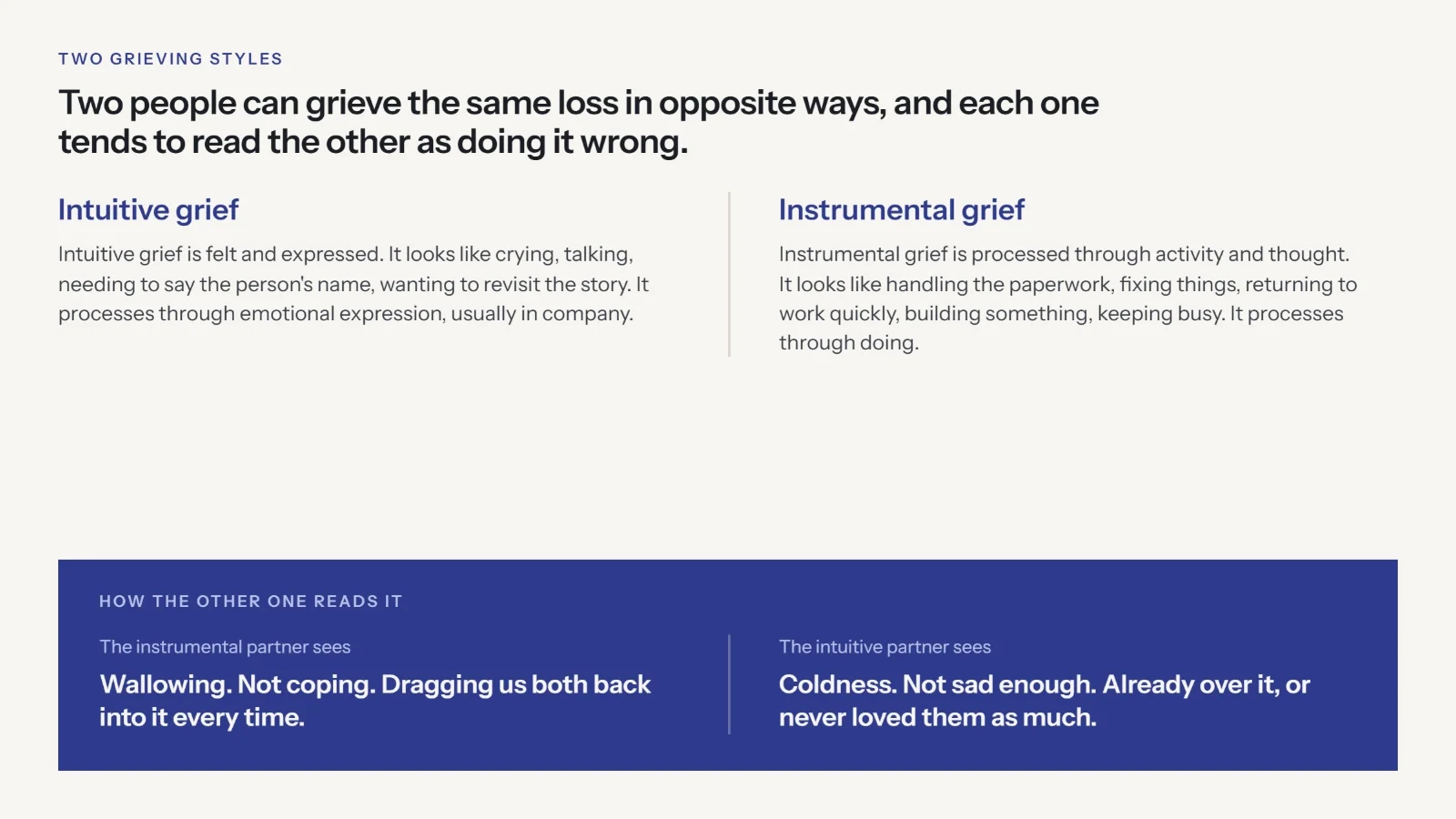
Grief researchers describe a spectrum between what are sometimes called intuitive and instrumental grieving styles.
Intuitive grief is felt and expressed. It looks like crying, talking, needing to say the person's name, wanting to revisit the story. It processes through emotional expression, usually in company.
Instrumental grief is processed through activity and thought. It looks like handling the paperwork, fixing things, returning to work quickly, building something, keeping busy. It processes through doing, usually alone.
Most people are a mix, but couples frequently sit at different points, and the difference maps loosely onto gender in ways that are more cultural than innate.
Here is the trouble. From an intuitive position, an instrumental partner appears not to be grieving at all, they seem cold, avoidant, already moved on. From an instrumental position, an intuitive partner appears to be sinking and pulling the household under.
Each partner is watching the other and concluding something is wrong with them. Both are grieving. Neither can see the other's version because it does not look like grief from where they are standing.
The clock problem
Separate from style, grief runs on unsynchronized schedules.
Grief arrives in waves, and two people's waves rarely align. On the day one of you is submerged, the other may be functioning. Three weeks later it reverses.
This produces two recurring injuries. The partner who is struggling reaches out and finds the other with no capacity to respond. And the partner having a better day feels guilty for it, or conceals it, which adds distance.
Neither person is failing. The waves simply do not synchronize, and expecting them to sets up a repeated disappointment that gets misread as not caring.
When the loss is a child
The dynamics above intensify sharply after the death of a child, which is why couples in that situation are unusually vulnerable to strain.
Two things compound. Each parent is in one of the most severe forms of grief there is, which leaves very little available for the other person, so the two people best positioned to understand are simultaneously the two least able to offer support. And each parent frequently carries a private version of blame, whether toward themselves, the other, or both, that goes unspoken for years.
Couples in this situation should not be attempting it unaided. This is among the clearest indications for professional support in all of bereavement, and seeking it early is not an admission that the relationship is failing.
What actually helps
Name it out loud. Most of the damage comes from silent interpretation. The single most useful sentence available is some version of: "We're doing this differently, and I've been reading yours as not caring. I don't think that's what it is." That conversation resolves an enormous amount on its own.
Stop requiring the other person to be your only support. Much of this strain comes from two people expecting each other to meet needs neither currently has capacity for. Individual counseling, a support group, or friends who can absorb the talking takes weight off the relationship. This is not a failure of the partnership; it is what makes it survivable.
Schedule the talking rather than ambushing it. A partner who does not want to talk about it at any moment is often willing to talk about it at an agreed one. Twenty minutes on Sunday works far better than a question at eleven at night.
Let the better day happen. If one of you is having a functional week, that is a resource for the household, not a betrayal of the person who died. Say it out loud so the guilt does not do the work silently.
Protect one non-grief thing. A walk, a show, a meal where the loss is not the subject. Couples who lose every ordinary thing they had together lose the relationship along with the person.
Get help early. Couples usually seek support after eighteen months of accumulated resentment, when the grief mismatch has been overlaid with a hundred smaller injuries. It is considerably easier at three months.
Where to read further
The distinction between instrumental and intuitive grieving styles comes from the work of Kenneth Doka and Terry Martin, and the American Psychological Association provides a general overview of how grief varies between people. Where the loss was a child, The Compassionate Friends runs chapters for bereaved parents across New Jersey and is worth knowing about alongside clinical support. If children are also in the house, how they grieve differs again, which we cover in our guide to grief counseling for children and teenagers. Where the mismatch has settled into the body rather than the conversation, the somatic work at our sister practice, the Center for Mind Body Balance, is often the way in.
Agreements that work better than conversations
Couples in this situation are usually advised to communicate more, which is reasonable and frequently useless, because the problem is not a shortage of conversation. It is that every conversation becomes a referendum on who is grieving correctly. What tends to work better is a small number of concrete agreements made once, while both of you are calm, and then simply followed.
- Agree a signal rather than a discussion. A word or a gesture that means I am having a bad hour and need you to not ask about it. It removes the need to explain at the exact moment explaining is hardest.
- Set a time to talk about the loss, and protect the rest. Twenty minutes on a Sunday is more sustainable than the possibility of it surfacing at any moment, which puts the quieter partner permanently on guard.
- Let each person mark the anniversary their own way. Doing it together is not more loving. Requiring it to be done together is where most anniversary arguments start.
- Stop keeping score on crying. Visible distress is a personality trait as much as a measure of love, and treating it as evidence is how couples end up arguing about who is sadder.
- Agree one thing you will do together. A walk, a meal, a drive. Not to talk about it, just to be in the same room doing the same thing. Shared activity does something shared conversation does not.
If the two of you have stopped talking about the person who died entirely, that is the point at which outside help is worth considering. Silence in a couple after a loss is rarely peace. It is usually two people each protecting the other from something, and it tends to harden if nobody interrupts it.
Frequently Asked Questions
Does my partner not caring mean they didn't love them?
Almost never. Instrumental grievers process through activity and often grieve intensely in private or through doing. The absence of visible emotion is a poor indicator of internal experience, and assuming otherwise is the most common misreading couples make after a loss.
Is it normal to feel resentful of my partner while we're both grieving?
Yes, and it is very common. Resentment usually builds where one partner feels their grief is taking up less space, or where reaching out has repeatedly met a partner with no capacity to respond. It is a signal about the mismatch rather than about the relationship, and it eases quickly once the mismatch is named.
Should we do grief counseling together or separately?
Often both. Individual work gives each person somewhere to grieve without managing the other's reaction; joint sessions address the pattern between you. Many couples start individually and add joint sessions once each has somewhere of their own to put it.
Before It Becomes a Second Loss

The conversation most couples have when they finally come in is some version of: I thought you had already moved on, and you thought I was never going to stop.
Both of them had been thinking it for months. Neither had said it. And in the meantime, a hundred small moments had been filed as evidence.
That is the actual risk here. Not that you grieve differently, which is unavoidable, but that months of private interpretation harden into a story about each other that outlasts the grief itself. Relationships that come apart after a loss usually come apart this way, slowly, through accumulated misreading, rather than through any single rupture.
It is much easier to interrupt at three months than at two years. Often a small number of sessions is enough, because the problem is rarely that the relationship is broken. It is that two people are running different processes and each has quietly concluded the other is doing it wrong.
We offer individual counseling and family support, and for many couples the useful combination is both, somewhere of your own to grieve, plus somewhere to work on what is happening between you.
A free call is fifteen minutes and costs nothing. Either of you can make it.
We see clients in person in Bergen County and across New Jersey by video.
Book a free call ·See our services
This blog post is for informational purposes only and does not constitute professional mental health advice, diagnosis, or treatment.