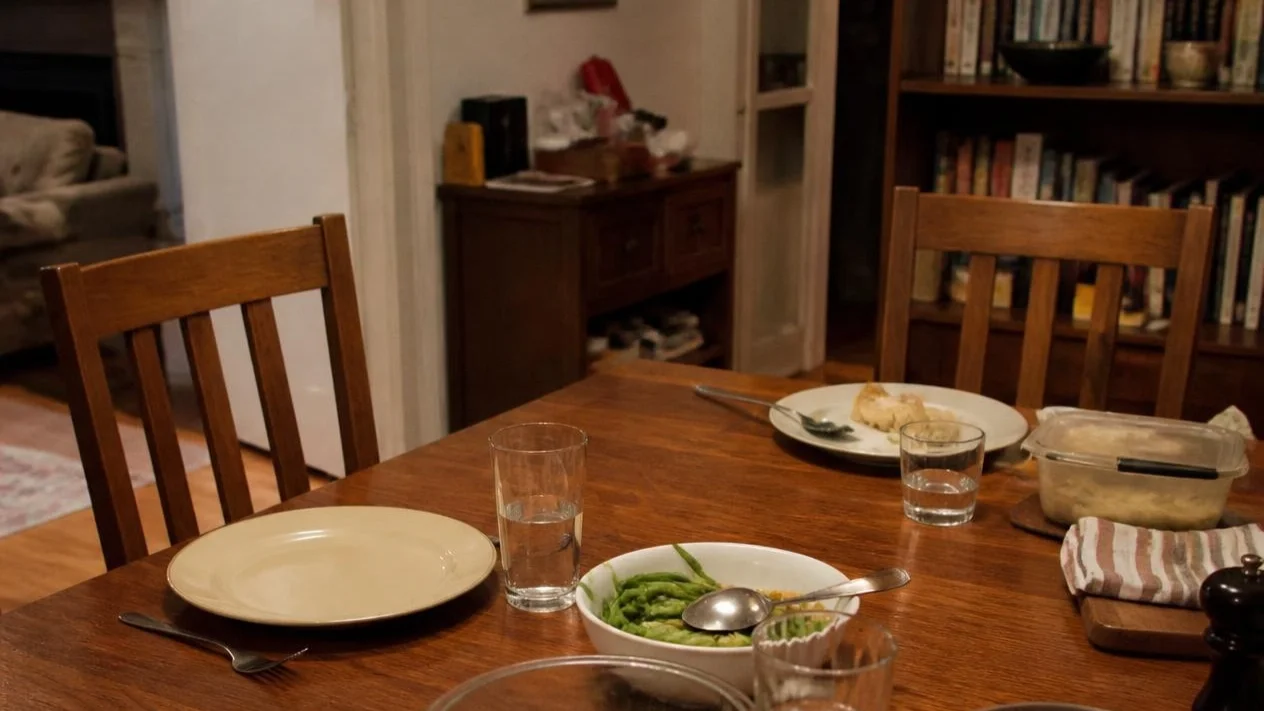
A woman visits her mother twice a week. Her mother is physically present, well cared for, and has not known who she is for two years. Nobody has died. There is no funeral to attend and no leave to take, and if she says out loud that she is grieving, someone will point out that her mother is still alive.
A man has not spoken to his son in four years. He does not know his address. The son is healthy and living a life, which is genuinely good news, and it does not make the loss smaller.
These are grief. They have a name, and the fact that they have a name matters more to people than almost anything else in this post.
What ambiguous loss means

The term was developed by Pauline Boss, whose work established that loss without a clear ending produces a distinct and more difficult form of grief. She described two versions.
In the first, the person is physically absent but psychologically present. Someone missing, a child given up for adoption, an estranged relative who is alive somewhere and thought about constantly. In the second, the person is physically present but psychologically absent. Dementia, severe brain injury, and active addiction all fall here: the body is in the room and the relationship is not.
Both share the defining feature, which is that nothing resolves. Ordinary grief, however painful, has a fact at its center that eventually becomes fixed. Ambiguous loss has a question at its center that stays open, sometimes for decades. That is why the standard grief guidance about acceptance and moving forward tends to land so badly. There is nothing stable to accept.
Estrangement
Family estrangement is far more common than its visibility suggests, because almost nobody discusses it. People carry it through holidays, weddings, and funerals while producing vague explanations about geography or busyness.
What makes estrangement particularly heavy is that it involves a choice, either yours or theirs, which means grief arrives fused with guilt, anger, and the constant background question of whether you should try again. Every birthday is a decision. Every phone call from an unknown number is a small event. Where a death eventually removes the possibility of contact, estrangement keeps it permanently open, and that openness is the wound.
People who initiated the estrangement often report the hardest version of this, because they receive the least sympathy. Having decided to protect yourself from someone does not stop you from grieving them, and it should not have to.
Dementia and cognitive decline
Dementia is often described as a long goodbye, which captures the duration but not quite the mechanism. What happens is a series of discrete losses over years: the loss of shared memory, of recognition, of the personality, of the specific relationship you had. Each is grieved separately, and the person who might normally have comforted you through such a loss is the person you are losing.
The Alzheimer's Association is clear that caregiver grief begins long before death, and this overlaps with what we describe in the post on anticipatory grief. The additional complication in dementia is that caregiving demands are highest exactly when grief is heaviest, so there is rarely room to feel it. People frequently report that the grief only arrives properly after the death, having been suspended for years by logistics.
The guilt in this situation is specific and common: relief at a good day being followed by shame, wishing for it to be over, or resenting a person for something they did not choose. None of that is a moral failure. It is what sustained caregiving does to people.
Addiction
Watching someone disappear into active addiction is ambiguous loss in a particularly cruel form, because the person surfaces intermittently. There are stretches where they are recognizably themselves, which restarts hope, and then the loss happens again. That cycle can repeat for years, and each round takes something.
Families in this situation often describe grieving someone who then walks into the kitchen. They also carry an unusual amount of shame, because addiction still attracts moral judgment in a way that other illnesses do not, which pushes the grief further underground.
Why it is harder than ordinary grief
- There is no ritual. No funeral, no service, no obituary. Rituals exist to make a loss public and shared, and without one the grief stays entirely private.
- There is no permission. Saying you are grieving a living person invites correction. Most people learn quickly not to mention it.
- Hope keeps reopening it. A card at Christmas, a lucid afternoon, three months of sobriety. Each one is genuinely good and each one restarts the process.
- The role has no name. There is no word for someone estranged from a child. There is no equivalent of widow. Language shapes what can be recognized.
- It has no end date. Ordinary grief has a start. This can run twenty years without a single marker.
This is the same mechanism we describe in disenfranchised grief, intensified by the fact that the situation itself never settles.
What actually helps
Boss's central insight, and the thing most people find useful, is that the goal is not to resolve the ambiguity. It cannot be resolved. The goal is to build tolerance for holding two true things at once.
- Say both things. My mother is alive and I have lost my mother. My son is well and I am grieving him. The instinct is to pick one because contradiction feels like confusion. Holding both is what makes the situation livable.
- Name it as grief out loud. Most people arrive having never once called it that, and having assumed the feeling was self-pity or bitterness. Naming it accurately relieves a surprising amount on its own.
- Build your own ritual. Since none is provided, make one. A date you mark, a letter you write and do not send, something planted. Grief needs somewhere to go, and inventing the container works nearly as well as inheriting one.
- Grieve the relationship rather than the person. What is gone is not a body but a bond, a role, and a future. Being specific about what exactly was lost makes it possible to mourn something rather than everything.
- Find people in the same position. Estrangement and dementia caregiving both isolate severely, and group support is often the fastest relief because it removes the need to justify the grief before describing it.
- Attend to the body. Chronic unresolved grief holds in the body over years, and long-running caregiving compounds it. Body-based work and the wider integrative team at the Center for Mind Body Balance can reach what talking alone does not.
- Decide about contact separately. Whether to reach out is a real question, and it is a different question from whether you are allowed to grieve. Working on the grief does not commit you to a decision about the relationship.
What to say when other people ask
One of the recurring difficulties in ambiguous loss is conversational rather than emotional. How is your mother? Do you have children? Are you close with your family? These are ordinary questions and each one requires a decision about how much of a complicated situation to hand a person who was making small talk.
The useful principle is that you owe nobody the full account, and having two or three prepared answers of different lengths removes the need to improvise while upset.
- A short answer that closes the topic. "We are not in touch at the moment." "She has dementia, so it is hard going." Complete sentences that do not invite follow-up.
- A medium answer for people you want to tell more. Enough detail to be honest, with a clear signal about whether you want to discuss it now.
- A full answer for the small number of people who have earned it. Most people find this list is shorter than they expected and that the relief of having even one person on it is considerable.
It also helps to decide in advance what you will do about family events where the situation becomes visible. Deciding at the doorway of a wedding reception is worse than deciding three weeks out, and choosing not to attend is a legitimate option rather than an admission of anything.
Frequently Asked Questions
Is it wrong to grieve someone who is still alive?
No. Grief responds to the loss of a bond, not to a death certificate. If the relationship you had is gone, the grief is accurate.
What if I chose the estrangement?
You can be certain a decision was right and grieve it fully at the same time. Those are not in conflict, and people who initiated a cutoff often need more support rather than less, because they get the least.
Will therapy pressure me to reconcile?
Not here. Reconciliation is your decision and it is not the measure of whether grief work succeeded. The work is about what you are carrying, not about producing a particular outcome with the other person.
Does this ever get easier if the situation never changes?
Generally yes, though differently than people expect. The situation does not resolve, but the capacity to live alongside it grows. If it has not shifted at all over a long period and is dominating your functioning, that is worth checking against prolonged grief.
Start with a conversation
If you have been carrying this for years without calling it grief, that is the most common way people arrive here.
Fifteen minutes, no charge, no obligation. Tell us what the situation is. We will listen, and help you work out what support would fit, whether that is individual sessions, a group, or a referral to someone better placed.
Call (201) 708-8448 or book a free 15 minute call. We see clients in Saddle River and across New Jersey by video and in person.
This blog post is for informational purposes only and does not constitute professional mental health advice, diagnosis, or treatment.