Introduction
The grief that follows the death of an animal companion is often more profound than people expect — and far more profound than the surrounding culture acknowledges. Here is why pet loss grief hits so hard, why it is real grief by every clinical measure, and what helps.
If you are in crisis right now, call or text 988 to reach the Suicide & Crisis Lifeline.
Why Pet Loss Hurts So Much: The Attachment Science
Pets are real attachment figures
Attachment theory — developed by John Bowlby and elaborated through decades of subsequent research — describes a small set of features that make a relationship an attachment relationship. These include physical proximity-seeking, comfort from the other's presence, distress at separation, and using the other as a secure base from which to engage the world. Companion animals, as the research on human-animal bonds compiled by the Human Animal Bond Research Institute demonstrates, meet all of these criteria for a great many of their humans.
When a pet dies, what is being lost is not just a being you cared for. It is an attachment figure. The nervous system response to losing an attachment figure is one of the most well-documented and most intense biological responses there is — and the species of the attachment figure does not change the underlying physiology.
Pets are also a daily-life infrastructure
Beyond attachment, pets are woven into the structure of daily life in a way that few human relationships are. The dog who needed walking shaped your morning. The cat who slept on the desk shaped your work hours. The rituals of feeding, grooming, vet visits, the play sessions, the greetings at the door — these were not peripheral. They were the texture of an enormous amount of your week. When the animal dies, all of that texture is gone at once, which is part of why pet grief so often produces the disorienting sense that the structure of the day has collapsed.
Pets often hold a unique relational role
Pets frequently occupy relational space that no human in the person's life can fill — the witness to solitude, the non-judgmental presence during illness or depression, the constant during years of upheaval, the bridge for children learning love and loss. Therapists who specialize in grief routinely encounter clients who describe their relationship with a deceased pet in terms more openly tender than they use for any human. This is not pathology. It is, often, accurate.
Pet Loss as Disenfranchised Grief
The term disenfranchised grief was coined by sociologist Kenneth Doka to describe grief that is not openly acknowledged, socially sanctioned, or publicly mourned. Pet loss is one of the most common forms of disenfranchised grief in modern Western culture — and we have written about disenfranchised grief and why it hurts so much in a dedicated post.
The structural problem
Most workplaces offer bereavement leave for human family members; very few extend it to pets. Most extended family members will attend a funeral for a person and would consider it strange to attend one for an animal. Most social structures that hold human grief — funerals, condolence cards, casseroles dropped at the door, the implicit permission to be visibly sad for weeks — do not activate for pet loss.
This is not a complaint about other people; it is a structural observation. The grieving person is left to do the full work of mourning without most of the cultural scaffolding that ordinarily supports it. Often they are also doing it in silence, because they have absorbed the message that to mourn this openly would be excessive.
The internal consequence
Disenfranchised grief tends to do more, not less, damage than acknowledged grief. The work of mourning still has to happen, but it happens without permission, often in private, and often with an added layer of shame: "I shouldn't be this affected." This shame compounds the loss and frequently turns ordinary, healthy grief into something that lingers in the body longer than it otherwise would. Naming pet loss as real grief — to oneself first — is often the most important early step.
The Physical Experience of Pet Loss Grief
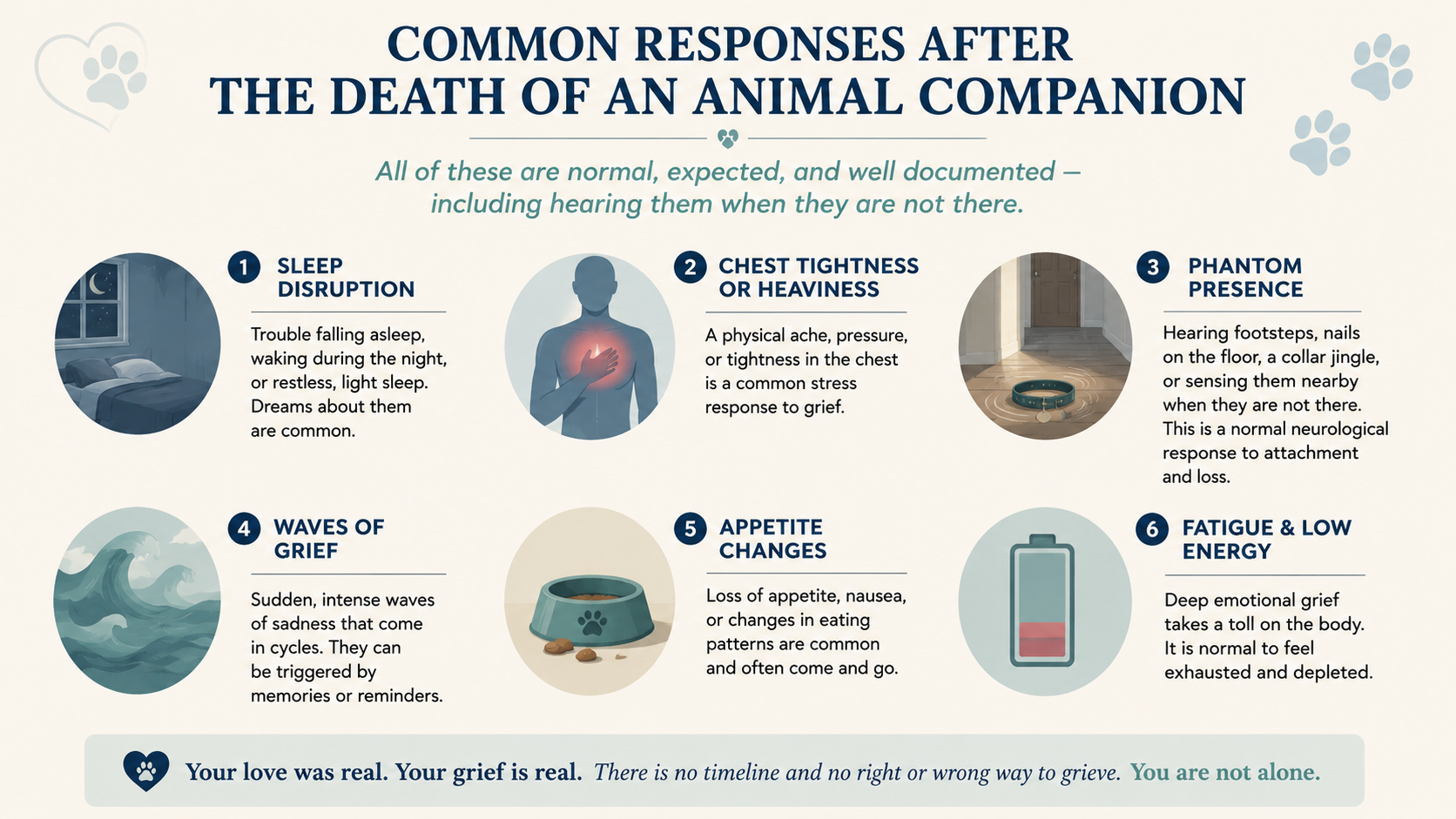
As with all grief, pet loss is a full-body event, not only an emotional one. The following responses are normal, expected, and well documented in the bereavement literature:
- Sleep disruption. Difficulty falling asleep, frequent waking, vivid dreams of the pet, the body waking at the time the pet usually needed something. The bedroom often holds particular grief because pets so often share it.
- Phantom presence. Hearing the pet's footsteps. Seeing them out of the corner of the eye. Reaching reflexively to the spot they always sat. These are common neurological responses to losing a constant sensory presence; they tend to ease over weeks and months.
- Chest tightness, heaviness, sighing. Pet loss grief, like all grief, frequently localizes in the chest. Many people describe a literal physical ache.
- Crying that arrives unbidden. Tears in the car, at the grocery store, while looking at the empty water bowl. This is the body discharging grief. It is healthy, even when inconvenient.
- Loss of appetite or comfort eating. Both responses are common and physiological, not character flaws.
- Difficulty around the daily structure the pet shaped. Mornings without the walk. Evenings without the greeting. These transitions are often the hardest part of the first weeks.
These somatic responses overlap significantly with what we describe in our post on grief and the body, and they respond to the same kinds of body-aware interventions.
Complications Specific to Pet Loss
Decisions about euthanasia
Many pet deaths involve the owner's active decision to end the animal's life. Euthanasia is, in nearly all cases, the right and most loving choice — but the grief afterward frequently includes acute guilt, second-guessing, intrusive thoughts about timing, and a difficult interior conversation about whether it should have happened sooner or later. This is one of the most clinically important aspects of pet loss grief to address with skilled support. Resources like the Cornell University College of Veterinary Medicine pet loss support hotline are also a valuable starting point.
Children grieving a pet
For many children, a pet's death is their first encounter with mortality. How adults handle that conversation matters enormously — both for the child's relationship with grief throughout their life and for the surviving family bond. Our post on grief counseling for children and teenagers addresses many of the principles that apply.
Anticipatory grief during a pet's decline
Owners caring for chronically ill or aging pets are often in a long anticipatory grief period before the actual death. We have written about anticipatory grief in detail — the principles apply directly to pet caregiving.
When the home itself becomes a trigger
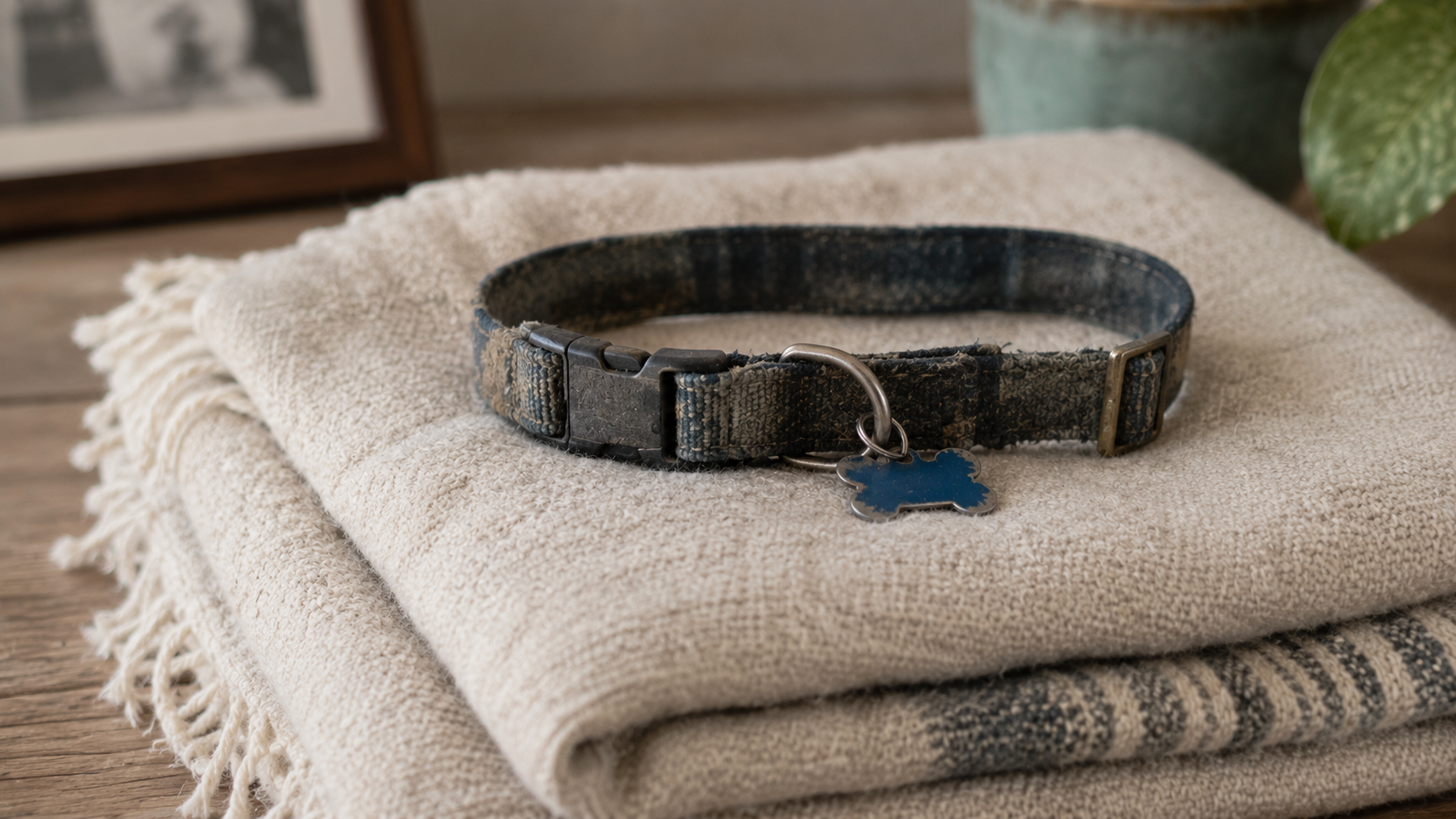
The empty bed, the unused food bowl, the chair where the cat slept — pet-loss grief is unusual in how thoroughly the physical home holds the loss. Some bereaved owners find substantial relief in deliberately reconfiguring the space, without rushing to erase the pet's presence. Others find ritual helpful — a photograph in a meaningful spot, the collar kept where it has always been. There is no right answer; what matters is bringing intention to the space rather than letting the absence sit unattended.
What Helps: Grief Support for Pet Loss
Naming it as real grief — to yourself first
Because the surrounding culture so often will not name pet loss as real grief, the bereaved person frequently has to do it for themselves. Saying it plainly — "this is grief, and it deserves the same respect I would give any other grief" — is not self-indulgence. It is the foundation of being able to mourn well.
Specialized pet loss support
A growing number of grief counselors specialize in or welcome pet loss work. Pet loss support groups — in person or online — are another evidence-based option, especially for the relief of being in a room with people who do not need the loss explained to them.
Body-based grief work
Pet grief is somatically loud. Body-based approaches — breathwork, somatic awareness, gentle movement — often provide more immediate relief than talk alone, because they meet the nervous system where the grief is actually living.
Ritual
Small ritual matters. A funeral or memorial — even an informal one with one or two people present — gives the grief a recognized container. A keepsake. A spot in the garden. A donation in the pet's name. These are not sentimental gestures; they are ways the psyche makes the loss real and metabolizes it.
Frequently Asked Questions
Is it normal to grieve a pet as much as a person?
Yes. Clinical research consistently finds that the grief response to pet loss is comparable in intensity to grief after the death of a human family member. The depth of your grief reflects the depth of the bond — not a failure of perspective. Anyone telling you otherwise is operating from a cultural assumption that the research does not support.
How do I stop feeling guilty about the decision to euthanize?
Guilt after euthanasia is close to universal, and it is usually a sign of how carefully you were weighing the decision rather than evidence that you got it wrong. Two questions tend to help more than reassurance: what information did you actually have at the time, and what would you have been asking your animal to endure by waiting longer? Persistent intrusive guilt that does not ease over weeks, or that centers on a specific moment you keep replaying, responds well to specialist grief work and rarely resolves through willpower alone.
How long should pet loss grief last?
There is no single answer, but most bereaved owners describe the most acute grief lasting weeks to a few months, with continued waves for a year or more. If grief is intensifying rather than easing, is significantly impairing daily functioning, or is producing persistent intrusive guilt about euthanasia decisions, specialist grief support is often valuable.
How do I help a child grieve the death of a pet?
Use clear, honest, age-appropriate language — "died," not "went to sleep" or "went away," which can make bedtime or departures frightening. Allow the child to express grief on their own timeline and in their own ways, which may look different from adult grief. Include them in any ritual or memorial that feels right. Our post on grief counseling for children and teenagers addresses this in more depth.

You Do Not Have to Justify This One
The hardest part of pet loss is rarely the death itself. It is the second week, when you are still not sleeping and someone at work asks how you are and you say fine, because the alternative is explaining that you are this undone over a cat.
That gap — between how much it hurts and how much you are allowed to say it hurts — is the actual injury. And it is why this particular grief so often goes underground and stays there, doing damage quietly, long after acknowledged grief would have started to ease.
So here is the thing worth hearing plainly. You do not have to make a case for this. Not to a counselor, not to a group, not to yourself. The bond was real, the loss is real, and the research is on your side.
If the guilt about a euthanasia decision is the part that will not let go — replaying the timing, wondering whether you waited too long or not long enough — that is the piece most worth bringing to someone trained in grief. It rarely resolves through reasoning alone, and it responds well to skilled support.
A free call costs nothing and does not commit you to anything. Fifteen minutes to say out loud what you have not been saying, and to find out whether individual work, a group, or simply hearing that this is normal is what would help.
We see clients in person in Bergen County and across New Jersey by video.
Book a free call · See our services · More resources on the blog
Disclaimer: This blog post is for informational purposes only and does not constitute professional mental health advice, diagnosis, or treatment. If you are in crisis, please call or text 988 (Suicide & Crisis Lifeline) or contact a licensed mental health professional immediately.