
Sleep is often the first thing grief takes and the last thing it gives back. Here is what is actually happening neurobiologically, why standard sleep advice frequently fails grieving people, and what evidence-based grief support does about it.
It is 3:14 a.m. You are awake, not anxious in any particular way you could name, not thinking about anything in particular, just awake. You will be awake for another two hours, possibly until morning. Tomorrow you will function. The day after, you will function. Three weeks of this, four weeks, eight weeks, and you will start to feel like a different person, hollowed out by something that no amount of sleep hygiene seems to address.
If you are grieving and not sleeping, this is not a discipline problem. It is not a willpower problem. It is not a problem of failing to follow the standard sleep advice you have already heard. It is a predictable, well-documented physiological response to loss, and it requires intervention that meets the body where the grief is actually living.
This post explores why grief disrupts sleep so reliably, why the usual sleep advice often does not work for bereaved people, and what evidence-based grief support actually does to help the nervous system find its way back to rest.
Loss is a chronic stressor at the level of the HPA axis
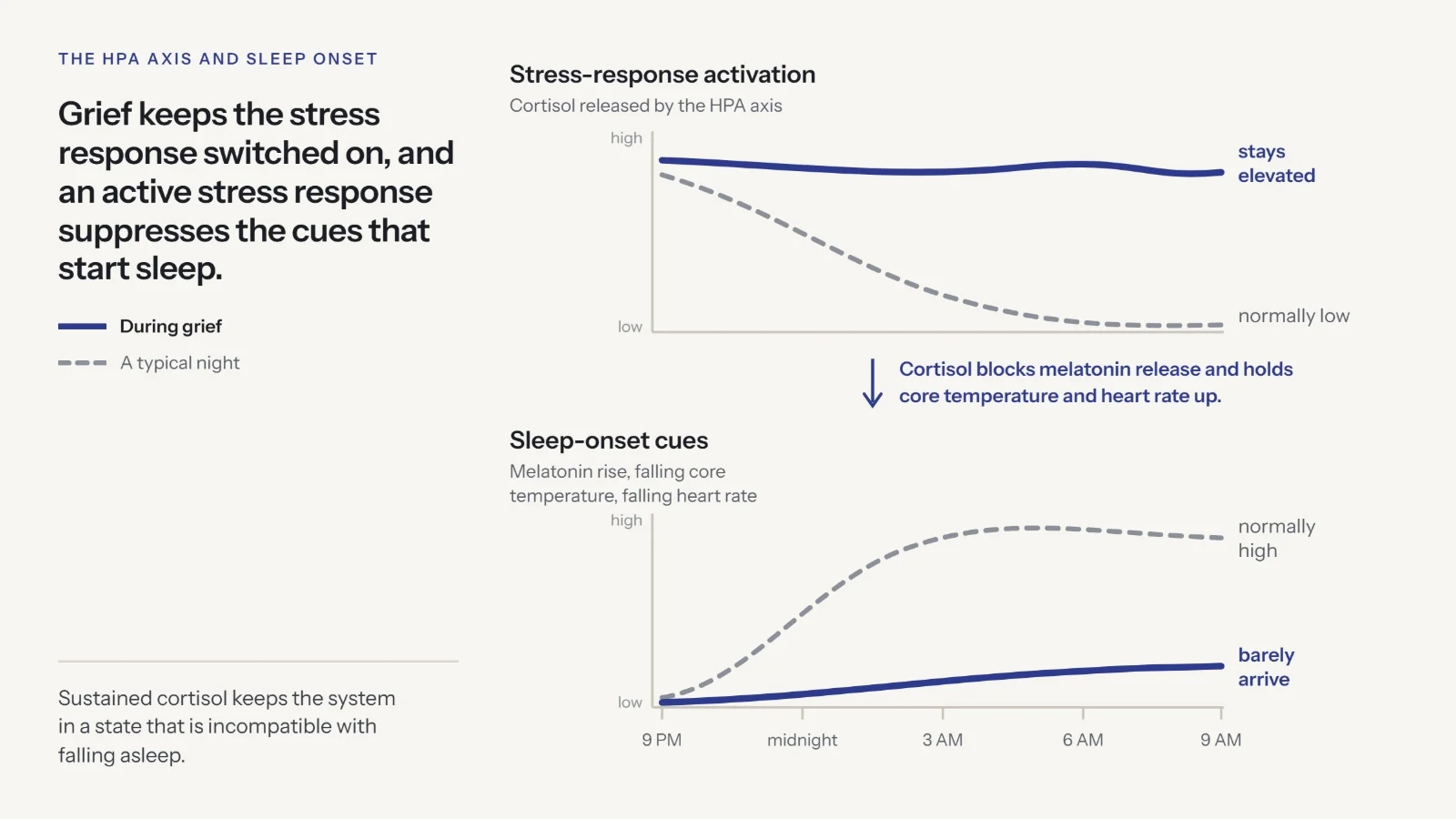
Sleep is regulated, at the deepest level, by the hypothalamic-pituitary-adrenal (HPA) axis, the body's chronic stress response system. Grief, particularly in its first weeks and months, is a sustained, high-magnitude activation of that system. Cortisol levels run higher and stay elevated longer in bereaved people than in non-bereaved controls, and this elevation directly suppresses the physiological cues that initiate and sustain sleep. Research published in Psychoneuroendocrinology and related journals has consistently documented this pattern.
The autonomic nervous system loses its set point
Beyond the HPA axis, grief disrupts the autonomic nervous system, the branch of the nervous system that runs heart rate, breath, digestion, and the felt sense of safety. The vagus nerve and the parasympathetic system that supports rest become less able to settle the body, and the sympathetic system that prepares for threat becomes more easily triggered. Polyvagal theory research documents this disruption directly, and it has profound implications for sleep: the nervous system that is supposed to downshift in the evening is, in early grief, often unable to do so.
The brain processes grief during sleep
Sleep is not passive. It is when the brain consolidates memory, processes emotional material, and integrates the day's experience. In grief, this work is unusually intense. The dreams are often vivid, sometimes overtly about the deceased, sometimes symbolic. Early-morning waking, a hallmark of grief and of depression, appears to be partly the consequence of the brain doing a great deal of overnight processing and rousing the body before the work is complete.
Why this is not the same as ordinary insomnia
Standard chronic insomnia and grief-related sleep disruption look similar from outside but are different inside. Ordinary insomnia often responds well to cognitive-behavioral therapy for insomnia (CBT-I), sleep hygiene practices, and behavioral interventions. Grief-related sleep disruption frequently does not respond fully to those interventions in isolation, because the underlying cause is not a sleep disorder but a nervous system in grief. Treating it primarily as an insomnia problem misses what is actually happening.
The Common Grief-Sleep Patterns
Bereavement-related sleep disruption tends to show up in a few characteristic patterns. Most grieving people experience some combination of these, often shifting from one to another as grief evolves.
- Difficulty falling asleep. The mind quiets just enough at bedtime to let everything that was being managed during the day rise to the surface. Many grieving people describe lying awake replaying the death, the funeral, the last conversation, not deliberately, but unable to stop.
- Early-morning waking. Waking at 3 or 4 a.m. and being unable to return to sleep. This is one of the most reliable patterns in both grief and depression and is linked to disrupted cortisol regulation.
- Frequent waking through the night. Shallow, fragmented sleep with multiple awakenings, often without a clear trigger. The nervous system is staying partly alert.
- Vivid or intense dreams. Dreams that feature the deceased, sometimes comforting, sometimes distressing, often emotionally heavy in either direction. This is the brain doing grief processing.
- Daytime fatigue that sleep does not fix. Even when sleep happens, it often does not restore. Grief is metabolically expensive, and the body remains depleted.
- Avoidance of bed. For some bereaved people, particularly those who lost a partner, the bed itself becomes the place where the absence is loudest. Going to sleep becomes something to be put off.
Why Standard Sleep Advice Often Fails Grieving People
If you have looked up sleep advice in the months since your loss, you have likely encountered the usual list: consistent bedtime, no screens before sleep, cool dark room, no caffeine after noon, exercise but not too late, journal if your mind is busy. None of this advice is wrong. Much of it can help at the margins. But it tends to underdeliver for grieving people, and understanding why is useful.
It treats the symptom, not the cause
Sleep hygiene addresses behaviors. Grief is a physiology. You can do everything right behaviorally and still wake at 3 a.m. because your HPA axis is running hot. The advice is not failing because you are doing it wrong; it is failing because it cannot reach the level at which the disruption is happening.
It often increases self-criticism
"I've tried everything" is a sentence we hear constantly from grieving clients who have, in fact, tried everything reasonable, and concluded that the problem must be them. The internalized failure compounds the grief. A more accurate framing: your body is responding the way grieving bodies respond. There is nothing wrong with you. The right intervention is grief support that addresses the nervous system, not better sleep discipline.
It can pathologize an adaptive response
Some sleep disruption in early grief is adaptive. The brain is doing work it needs to do. Pushing too hard to suppress that work, particularly with sedating medications used as a first response, can interrupt the very processing that grief recovery depends on. This does not mean medication is never appropriate (it sometimes is, in close consultation with a prescribing clinician), but it means sleep disruption in early grief is not always a problem to be eliminated.
Address the nervous system, not the sleep
Body-aware grief work, breathwork, somatic awareness, gentle nervous system regulation practices, works on the underlying autonomic state that is producing the sleep disruption. As the daytime baseline nervous system arousal comes down through this work, sleep tends to return. We describe these approaches in detail in our post on grief and the body.
A simple practice: extended-exhale breath before bed
This is one of the most reliable single interventions for grief-related sleep disruption. It works because the extended exhale directly activates the vagal brake on the sympathetic nervous system, lowering arousal at the physiological level.
- Lie in bed in your normal sleep position
- Breathe in slowly through the nose for a count of four
- Breathe out slowly through the mouth for a count of six to eight (the exhale should be longer than the inhale)
- Continue for five to ten minutes without trying to fall asleep, the goal is the breath, not the sleep
- If thoughts arise, return to the count without judgment
Research on slow-breathing interventions published in peer-reviewed journals, including work in \Scientific Reports\, supports extended-exhale breathing as a clinically effective tool for autonomic nervous system regulation.
Specialized grief counseling, including for sleep
A skilled grief counselor will not treat your sleep problem as a sleep problem. They will treat it as one of the body's signals of the grief that is being processed underneath it. Working through the grief, with talk, with body-aware practices, with the relational safety of a strong therapeutic alliance, tends to restore sleep as a side effect, often more durably than direct sleep interventions. Our guide on how to choose a grief counselor in Bergen County offers a framework for finding the right fit.
When sleep disruption signals something more
If sleep disruption persists strongly beyond the first six to twelve months, or if it is accompanied by intensifying intrusive thoughts, hopelessness, or inability to function, it may be a signal that grief has become complicated. Our post on complicated grief and prolonged grief disorder describes when grief has moved into territory that warrants specialist clinical attention.
Working with a prescribing clinician when needed
Sometimes short-term sleep support medication, prescribed and monitored by a physician or psychiatrist, is the right tool. This is a clinical decision that should be made in consultation with someone who knows your full medical history and who understands grief, not based on what worked for a friend. The goal is generally short-term support that allows the grief work to proceed, not long-term suppression of the grief processing the brain is trying to do.
Where to read further
For the breathing and nervous system side of this, the Center for Mind Body Balance runs breathwork sessions in the same building, and its guide to a 10 minute daily practice pairs directly with the exercise above.
Frequently Asked Questions
How long will grief-related insomnia last?
Sleep disruption is most intense in the first weeks to months after a loss and generally improves as grief integrates. For many people, meaningful sleep recovery follows the same arc as the rest of the grief, gradual, non-linear, and tied to broader nervous system regulation. If sleep disruption remains severe beyond six to twelve months, or is paired with intensifying grief symptoms, specialist evaluation is warranted.
Should I take sleep medication for grief insomnia?
Sometimes yes, often no, and it should always be a clinical conversation with a prescribing physician who understands grief, not a self-prescribed solution. Short-term, targeted medication can be valuable when sleep deprivation is itself becoming a serious problem. Long-term sedation tends to interfere with the grief processing the brain is trying to do, and is rarely the right answer.
Why does grief make me wake up at the same time every night?
Early-morning waking, particularly between 3 and 5 a.m., is one of the most characteristic patterns of grief and depression. It is linked to disrupted cortisol regulation, which produces an early-morning arousal spike. It is a physiological phenomenon, not a personal failing, and it tends to ease as the underlying nervous system dysregulation eases.
Grief Unbound: Compassionate Support for All Types of Loss
At Grief Unbound, we treat grief as a whole-person experience, cognitive, emotional, relational, and somatic. Our practice integrates evidence-based talk therapy with body-aware practices so we are working with grief at every level where it lives, not just the level that language can reach.
We offer individual counseling, family support, support groups, and telehealth, serving Bergen County, NJ residents in person and clients across New Jersey by video.
Schedule your first session with Grief Unbound. book a first session, or schedule a free call to talk through fit first.
Or explore more of our resources on the Grief Unbound blog.
This blog post is for informational purposes only and does not constitute professional mental health advice, diagnosis, or treatment.