
Everyone warns you about the sadness. Nobody warns you that you are going to be furious.
Furious at the hospital. At your brother, for the thing he said at the funeral. At your friend, for complaining about her mother. At strangers in traffic, entirely out of proportion.
And underneath all of it, the one almost nobody says out loud: furious at the person who died.
If you are in crisis right now, call or text 988 to reach the Suicide & Crisis Lifeline.
Anger is one of the most common and least discussed features of grief. It shows up as irritability with people who did nothing wrong, rage at doctors or family, and often as fury at the person who died. Grief anger is not a failure of love or a stage to move past. It is usually pain that has not found any other route out.
- Grief anger is extremely common and rarely discussed, which leaves many bereaved people believing their reaction is abnormal.
- Anger at the person who died is normal, does not mean you loved them less, and is often the most useful thing in the room once it can be spoken.
- Anger is usually a surface emotion covering helplessness, fear, guilt, or abandonment. Working with what sits underneath is what shifts it.
Why grief produces anger
Anger is what helplessness turns into. Grief is total powerlessness, you could not prevent it and cannot undo it. Humans tolerate helplessness poorly, and anger is the emotion that converts it into something with direction. Being furious at a doctor is more bearable than facing that nobody could have stopped it.
Anger is physiologically activating. Grief is depleting; anger is mobilizing. For a system flattened by loss, anger can be the only state that produces energy. This is part of why it feels almost relieving, and why people sometimes reach for it.
The nervous system is already at the threshold. Grief keeps the stress system elevated. A system running hot has almost no headroom, so ordinary friction, a slow driver, a question asked twice, meets a nervous system with nothing left to absorb it. That is the irritability, and it is physiological rather than characterological.
And sometimes the anger is simply accurate. Care was mishandled. A family member behaved badly. The death was preventable. Not all grief anger is displaced, and treating legitimate anger as a symptom to be managed is its own injury.
Anger at the person who died
This is the one people carry silently, often for years.
They left. They did not take care of themselves. They did not tell you how bad it was. They made you promise something impossible. They died before the conversation you were going to have. They left you with the house, the debts, the family, the mess.
Being angry at someone who died is normal, common, and does not mean you loved them less. It usually means the opposite, that the relationship was substantial enough to hold contradiction.
The reason it is so rarely spoken is that death confers a kind of immunity. Speaking ill of the dead feels forbidden, and being angry at someone who cannot answer feels both futile and cruel. So it goes underground, and undergrounded anger tends to convert into guilt, which is considerably harder to work with.
In grief work, this is often the most productive thing in the room. Not because the anger needs justifying, but because saying it out loud usually reveals what is underneath, abandonment, fear, or a specific unfinished conversation.
What sits underneath
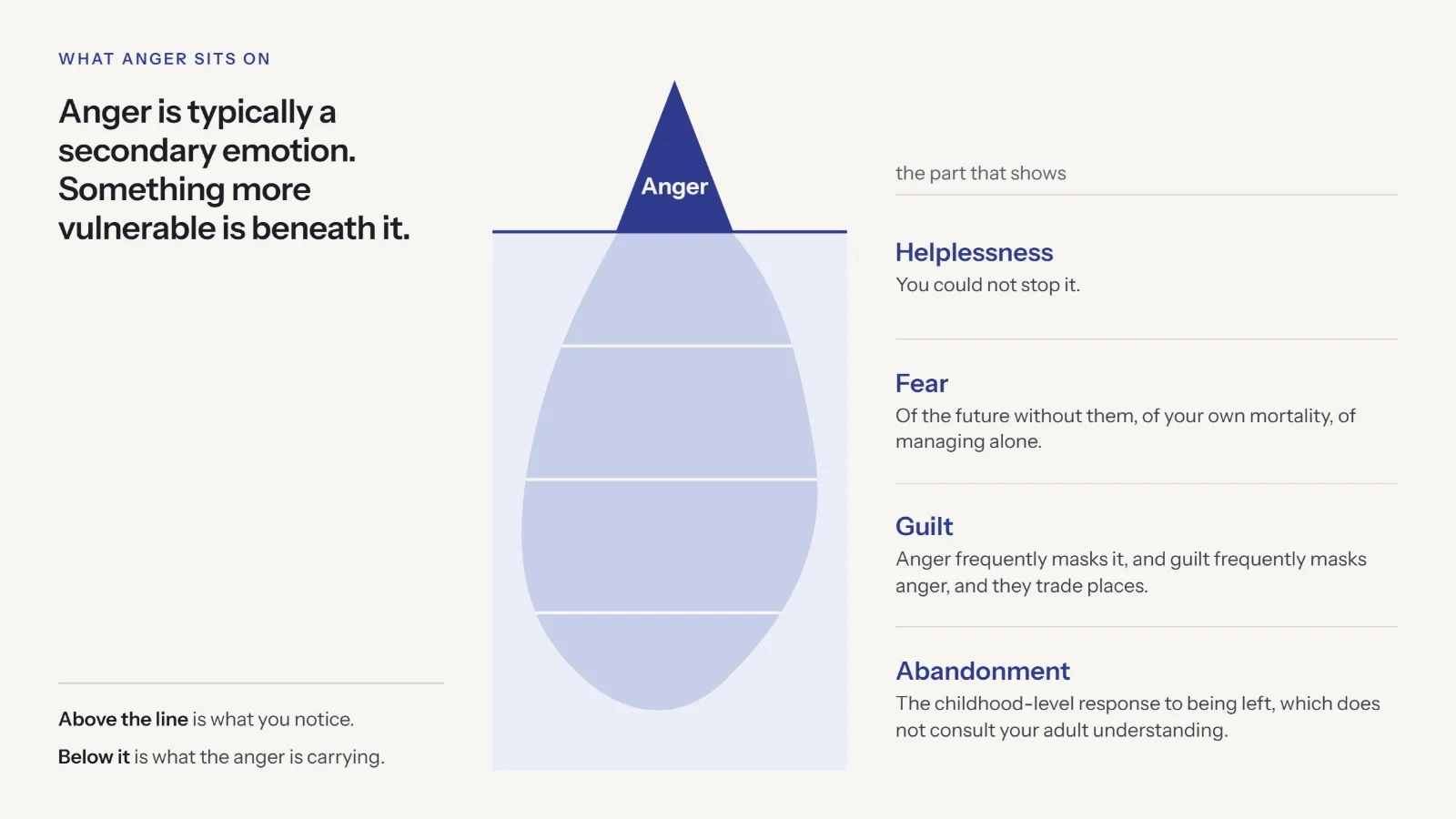
Anger is typically a secondary emotion. Something more vulnerable is beneath it.
Helplessness, you could not stop it. Fear, of the future without them, of your own mortality, of managing alone. Guilt, anger frequently masks it, and guilt frequently masks anger, and they trade places. Abandonment, the childhood-level response to being left, which does not consult your adult understanding of the circumstances.
Asking what the anger is protecting usually moves things faster than trying to make it stop.
On the "anger stage"
The stages model, denial, anger, bargaining, depression, acceptance, is the most widely known idea about grief and one of the most misapplied.
Kübler-Ross developed it observing terminally ill patients facing their own deaths, not bereaved people. It was never a sequence, and it was not intended as a checklist for mourners. Grief does not proceed in order, and no one moves through anger and finishes with it.
This matters practically, because people who expect anger as a phase they will complete tend to conclude that something is wrong when it returns eighteen months later. Nothing is wrong. Grief is not linear and anger recurs.
What helps
Say it to someone who will not flinch. The single most useful intervention is speaking the anger out loud, in full, to a person who does not need to correct or reassure you. This is one of the clearest arguments for a grief specialist or a support group over the friend who will say "but she was in so much pain."
Give it a physical route. Anger is a mobilizing state, it produces energy that wants to move. Walking hard, swimming, splitting wood, anything vigorous. This is not a metaphor; the activation is physical and does better with a physical outlet than with insight. Body-based approaches such as somatic work address the same mechanism.
Write the unsendable thing. Write directly to the person, without editing, without kindness. Nobody reads it. This one is unreasonably effective, particularly for anger at the dead.
Protect the relationships taking the overflow. Grief anger frequently lands on the people nearest, who did nothing. Telling them what is happening, "I'm short with you and it isn't about you", prevents a secondary loss on top of the first.
Watch what you are reaching for. Alcohol, driving fast, picking fights. The relief is real and short, and the cost accumulates.
When to get help
Grief anger warrants clinical attention when it is frightening you, when it is damaging relationships or your work, when it has become the only accessible emotion, when it is turning inward as self-blame, or when it is not shifting at all over many months. Persistent anger is one feature associated with prolonged grief disorder. Our post on complicated grief covers the fuller picture.
If anger has ever moved toward hurting yourself or anyone else, that is not a wait-and-see situation. Call or text 988, or go to an emergency room.
Where to read further
If the anger is bound up with a loss you have not been able to describe to anyone, that is usually a sign for group support rather than more time. Where it is sitting in the body as tension, clenching or a permanently short fuse, the Center for Mind Body Balance offers breathwork and somatic sessions that reach what talking does not.
When the anger lands on the family
Grief anger rarely stays where it belongs. It is difficult to be furious with someone who has died, and almost impossible to be furious with an illness, so it tends to find a target that can actually receive it. That target is usually a family member, and usually the one closest to hand.
Estates and belongings are where this surfaces most reliably. Arguments about a house, a ring, or who gets the photographs are almost never about the object. They are about who was there at the end, who did the caregiving, who visited and who did not, and whose grief the family has been treating as the important one. Those questions are real and mostly unspeakable, so they attach to something concrete instead.
It helps to name what the argument is actually about, even if only to yourself before you walk into the room. It also helps to know that families reliably fracture in the first year after a death and reliably repair afterwards, and that saying something unforgivable to a sibling at month four is common enough to be almost predictable. That does not excuse it. It does mean it is usually recoverable.
If the anger is directed at the person who died and you cannot say that out loud to anyone in your family, that is one of the clearest indications for a group. A room of people who have each privately been furious with someone they loved removes the shame faster than any amount of reasoning.
Frequently Asked Questions
Is it normal to be angry at the person who died?
Yes, and it is one of the most common experiences in grief as well as one of the least admitted. It does not mean you loved them less. It usually means the relationship was substantial enough to contain contradiction. Anger at the dead most often responds well to being spoken aloud to someone who will not rush to defend them.
Why am I angry at people who did nothing wrong?
Grief keeps the stress system elevated, which leaves almost no capacity to absorb ordinary friction. Minor irritations meet a nervous system with no headroom. This is physiological rather than a change in who you are, and it eases as the underlying activation settles.
Is anger a stage of grief I'll get through?
Not in the way the stages model implies. Kübler-Ross described people facing their own terminal illness, not the bereaved, and never intended a fixed sequence. Anger recurs rather than completing, and its return months or years later is not a setback.
You Can Say It Here

There is a specific sentence a lot of bereaved people have not said to anyone.
Some version of: I am so angry at them. For leaving. For not taking care of themselves. For not telling me. For dying before we fixed it.
They have not said it because the people around them would rush to defend the dead, or look uncomfortable, or gently suggest that what they really mean is that they miss them. So it stays in, converts to guilt, and gets heavier.
A grief specialist is one of the few people who will simply let you say it. Not correct it, not soften it, not reassure you that you do not really mean it. Just hear it, and then help you find out what is underneath, which is usually the part that has actually been hurting.
If the anger has been frightening you, or landing on people who did not deserve it, that is worth a conversation rather than another month of managing it alone.
A free call is fifteen minutes and commits you to nothing.
We see clients in person in Bergen County and across New Jersey by video.
Book a free call ·See our services
This blog post is for informational purposes only and does not constitute professional mental health advice, diagnosis, or treatment.