
Introduction
Losing a parent as an adult is one of the most common and most dismissed forms of grief. The world expects you to be "okay" because the loss was "in the natural order." Your nervous system rarely agrees. Here is what adult-child grief actually is — and what helps.
Why Losing a Parent Hits Differently Than Other Losses
Parental loss is one of the only griefs that nearly everyone will experience and that the surrounding culture treats as routine. Both halves of that sentence matter, and they sit in tension.
The attachment system was first built around your parent
Attachment research — beginning with John Bowlby and elaborated by Mary Ainsworth and decades of subsequent developmental neuroscience — has established that the early bond with a parent is not just one important relationship. It is the template through which the developing nervous system learns what safety, connection, and co-regulation feel like. The relational patterns formed in those earliest years shape, in measurable ways, how the adult nervous system responds to stress, intimacy, and loss for the rest of life.
When a parent dies, what is being lost is not only a current relationship. It is, at the somatic and neurological level, the original template of safety. Even if the adult relationship had been complicated, distant, or estranged for years, the older substrate underneath it does not disappear. The body still registers the death of a parent the way it registers the death of an attachment figure — because that is, structurally, what it is.
The cultural script makes it worse
There is a widely circulated assumption — often implicit, sometimes spoken out loud — that losing a parent in adulthood is grief on easy mode. The parents lived a long life. The death was expected. You are an adult; you have your own life now. People are sorry, but they expect you to move through it quickly. Bereavement leave is short. Co-workers stop asking after a week or two. The grief, the cultural script implies, should be proportional to its inconvenience.
The lived experience of adult children rarely matches this. Grief researchers have documented that adult-child grief frequently lasts longer, dips deeper, and surfaces in more unexpected places than the surrounding culture expects. Anniversaries land hard for years. Smells, songs, and offhand phrases ambush you in grocery stores. Holidays reshape themselves into something unrecognizable. None of this is pathological. It is the body and the psyche doing what they do when an attachment of decades comes to an end.
The Physical Experience of Parental Loss
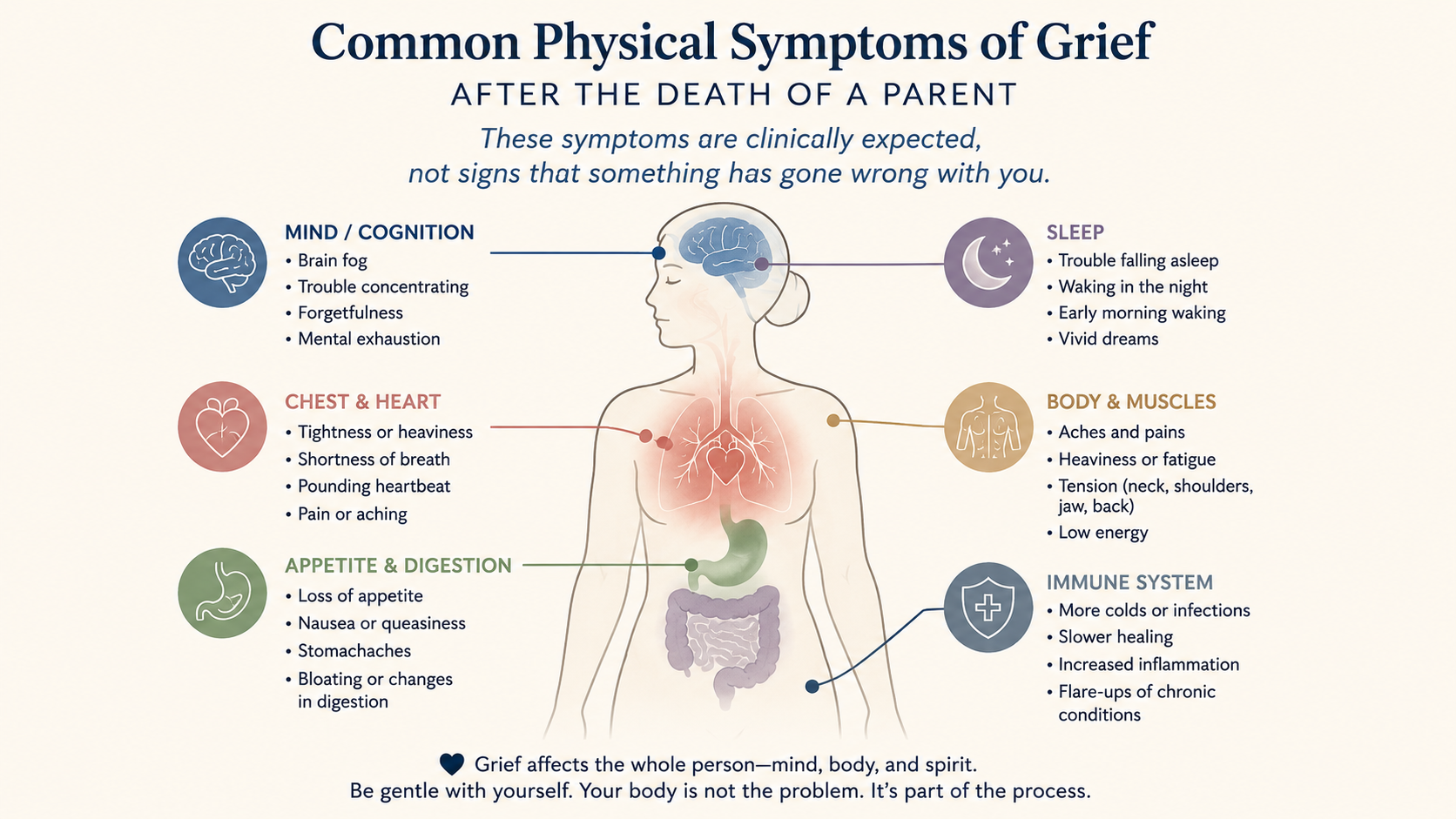
Because adult-child grief is so widely minimized, many bereaved adults are surprised — even alarmed — by how strongly the loss shows up in their body. The following are common and clinically expected, not signs that something is wrong with you.
- Fatigue that sleep does not resolve. Grief is metabolically demanding. The sustained nervous system activation, disrupted sleep, and ongoing emotional processing produce a depletion that ordinary rest cannot fully reach.
- Chest tightness or a felt heaviness in the heart area. Many people locate parental grief physically in the chest — a pressure, a held breath, a difficulty drawing a full inhale. These sensations are real and tied to autonomic nervous system activation.
- Appetite disruption, in both directions. Loss of appetite and increased eating are both common, both physiological, and neither is a character failing.
- Sleep disruption. Difficulty falling asleep, frequent waking, vivid dreams, and early morning waking are characteristic of grief, related to its impact on stress hormone regulation.
- Cognitive symptoms — forgetfulness, distraction, the famous "grief brain." Grief consumes substantial cognitive resources. The forgetfulness, slowness, and difficulty concentrating that often accompany the first months are not signs of decline. They are signs of a brain doing a great deal of underground work.
- Increased susceptibility to illness. Bereavement-related immune suppression has been documented in peer-reviewed research, which is part of why many bereaved adults notice they get sick more often in the year following a significant loss.
All of these are predictable consequences of how grief lives in the body, not only in the mind. We explore this in greater depth in our post on grief and the body.
Complications Specific to Adult-Child Grief
Complicated parent relationships do not simplify after death
If your relationship with the parent who died was conflicted, distant, abusive, or recently estranged, the grief is often more — not less — complex. The bereaved adult is now mourning not just the person but the relationship that never happened, the repair that will never occur, and the version of themselves that needed something the parent could not give. This is sometimes called complicated bereavement or ambiguous grief, and it benefits significantly from skilled clinical support.
The 'next-in-line' awareness
For many adult children, the death of a parent shifts something fundamental about mortality. You are now the generation that goes next. This is not a morbid thought — it is an accurate one — and integrating it psychologically takes real work. Existential grief is part of parental loss for nearly everyone, and it is often the dimension that emerges most strongly six to twelve months after the death, once the practical aftermath has settled.
Sibling dynamics and unresolved family systems
Parental death routinely surfaces — or detonates — sibling and family dynamics that were held in place by the parent's presence. Estate disputes, caregiving inequities, old wounds about who was favored, decisions about parents' belongings, decisions about a surviving parent's care — all of these create grief layers that sit on top of the grief for the parent themselves. This is one reason adult-child grief often calls for both individual and family therapeutic support.
Losing one parent while the other now needs care
If a surviving parent is now alone, or now requires care, the bereaved adult is grieving while also taking on substantial new responsibility. The grief and the caregiving feed each other in difficult ways. Our resources on anticipatory grief often apply to this situation as well.
What Helps: Evidence-Based Support for Adult-Child Grief
Individual grief counseling with a specialist
Generalist therapy is helpful for many things. Grief is not always one of them. A specialist in grief — particularly one trained in modalities like complicated grief therapy, somatic experiencing, and trauma-informed approaches — can offer a quality of presence and clinical knowledge that a generalist may not have. We discuss this more in our guide on how to choose a grief counselor in Bergen County.
Body-based and somatic work
Because parental grief lives so strongly in the nervous system, body-based approaches — breathwork, somatic awareness, gentle movement, sometimes bodywork — often reach what talk therapy alone cannot. The Somatic Experiencing International community has documented how loss-related dysregulation responds to body-aware intervention in ways that purely cognitive work does not.
Peer support and grief groups
There is a particular relief that comes from being in a room with other adults who have lost a parent — adults who recognize, without explanation, what "I keep almost calling her" or "I forgot for a second this morning" actually means. Group grief support is often a complement to individual work rather than a replacement for it. Our post on grief support groups describes what to expect.
Time, ritual, and the cultural permission to grieve
Grief is one of the few things in modern life that genuinely cannot be optimized, hacked, or accelerated. It needs time it does not get. It benefits from ritual — even improvised personal ritual — far more than most contemporary adults realize. And it suffers in a culture that has, as we have written about elsewhere, largely forgotten how to make room for it.
When to consider whether grief has become complicated
Some grief, despite all good support, intensifies rather than easing — or becomes so consuming that ordinary functioning is disrupted for an extended period. This is sometimes prolonged grief disorder, now formally recognized in the DSM-5-TR. Our post on complicated grief and prolonged grief disorder offers more on recognizing when grief has moved into territory that needs specialist clinical care.
Frequently Asked Questions
How long does grief after the loss of a parent last?
There is no fixed timeline. Most bereaved adults experience the most intense grief in the first six to twelve months, with continued waves — often around anniversaries, birthdays, and holidays — for years afterward. Grief does not end; it integrates. If grief is intensifying rather than easing after the first year, or is significantly impairing daily functioning, that warrants specialist clinical evaluation.
Is it normal to feel relief along with grief after a parent dies?
Yes — particularly if the parent had been ill, suffering, or in a long decline. Relief is not a betrayal. It is a healthy response to the end of suffering, and it frequently coexists with deep grief. Both feelings are real; neither cancels the other. A skilled grief counselor can help you hold both without forcing them into a single tidy narrative.
Should I see a grief counselor or a general therapist?
For parental grief specifically, a counselor with explicit grief training is often the better fit — they will not pathologize what is, in fact, a normal grief response, and they will recognize patterns specific to bereavement that a generalist may not. This is especially true if your existing therapist has not worked extensively with loss.
Do I have to be in Bergen County to work with you?
No. We see clients in person in Bergen County and work with people across New Jersey by video. Grief counseling translates to telehealth better than many people expect — what the work requires is attention and continuity, not proximity.

Nobody Around You Will Ask Twice
The hardest part of this particular grief is rarely the funeral. It is month four, when the casseroles have stopped, the estate paperwork is mostly done, and everyone around you has quietly filed your loss under handled.
You are still waking at four in the morning. You still reach for the phone on Sundays. And there is now no socially available way to say so, because the window in which people expect you to be grieving has closed and you are still standing in it.
That gap is the reason grief support exists. Not because something has gone wrong with you, but because a loss of this size needs somewhere to be spoken about long after the world has moved on — and one hour a week where nobody is measuring how you are doing against a schedule.
If you are unsure whether what you are experiencing warrants professional support, that uncertainty is itself common, and it is worth a conversation rather than a decision made alone at 2am. A free call costs you nothing and can clarify quickly whether specialist grief work would help, whether a group would serve you better, or whether what you need is simply to hear that this is normal.
We see clients in person in Bergen County and across New Jersey by video.
Schedule a free consultation call or book a first session
Or explore more resources on the Grief Unbound blog.
Disclaimer: This blog post is for informational purposes only and does not constitute professional mental health advice, diagnosis, or treatment. If you are in crisis, please call or text 988 (Suicide & Crisis Lifeline) or contact a licensed mental health professional immediately.