Cleaning the closet
The clothes are still in the wardrobe. It has been fourteen months, your sister has mentioned it twice, and every time you open the door you close it again.
This is one of the most searched questions in grief and one of the least written about honestly. Here is why it is hard, what tends to work, and why the timeline you have been given is not real.
Why objects are so difficult
Three things are happening at once, and separating them helps.
The first is sensory. A coat holds a smell, and smell reaches memory more directly than any other sense, bypassing the interpretive machinery entirely. A jumper is not a reminder of the person. For a few seconds it is very nearly the person. That is why people who manage the paperwork and the service without difficulty come apart at a drawer.
The second is that objects are the last thing they touched. Handwriting on a shopping list. A book with a page turned down. These are traces of an ordinary day that was not supposed to be the last one, and they carry the fact of the interruption in a way that nothing formal does.
The third is that deciding about the objects feels like deciding about the person. Letting go of the coat feels like a statement about how much they mattered, which is not rational and is nonetheless what it feels like at the wardrobe door.
Add to that the physical exhaustion of early grief, which we cover in grief and the body, and the executive function this task actually demands, and it becomes clear why so many people simply close the door.
There is no deadline
People will imply one. A well-meaning friend at three months. A sibling at a year. An assumption in the air that a certain amount of time has passed and something should have happened by now.
There is no clinical basis for any of it. Some people clear a house in a fortnight and grieve perfectly well. Others keep a room untouched for five years and are entirely functional. Neither is a symptom.
What matters is not how long it takes but whether the arrangement is workable. A wardrobe left as it was because you are not ready is fine. A wardrobe left as it was because you cannot enter the room at all, three years on, is worth a conversation, and we come back to that at the end.
One caution about the opposite direction. Clearing everything fast, in the first weeks, is sometimes exactly right and is sometimes a way of getting through a task while numb, before the loss has landed. People occasionally regret it. If someone is urging speed, it is worth asking whose discomfort the speed is serving.
A way through that does not require deciding everything
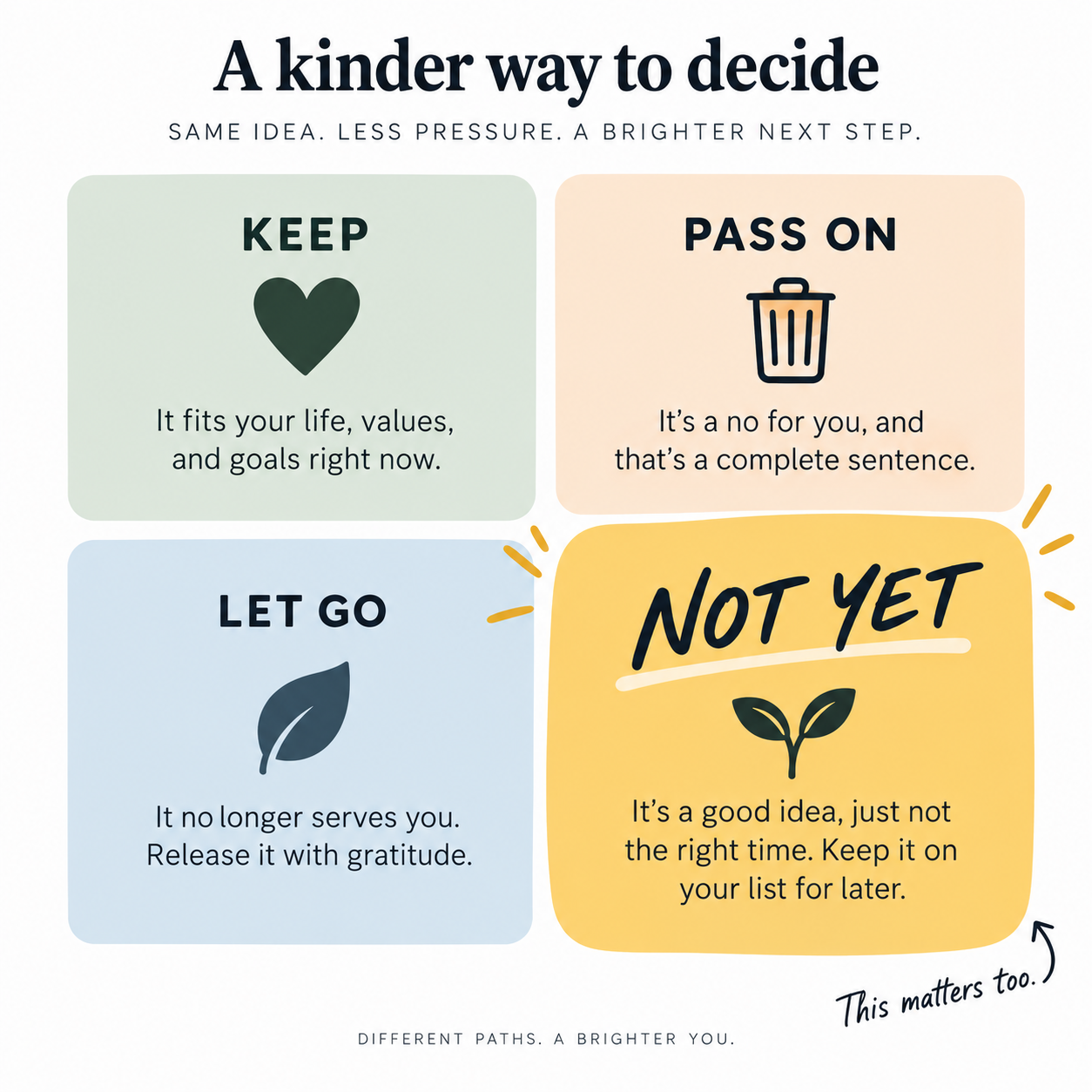
The standard advice offers three categories: keep, pass on, let go. The reason it fails is that every difficult object goes into an unspoken fourth pile, and since that pile does not officially exist, the whole process stalls.
So make it official. Keep, pass on, let go, and not yet.
Not yet gets a box. The box gets closed and put somewhere. You do not have to look in it again for a year, and you are allowed to have as many as you need. The purpose is that the presence of a legitimate destination for the hard things is what makes the easy things possible. Almost everyone finds that once not yet exists, a surprising amount turns out to be straightforward.
- Start with the least loaded room. Not the wardrobe. The garage, the kitchen drawers, the linen cupboard. Build some momentum on things that do not carry them.
- Set a timer and stop when it goes. Forty minutes is plenty. This is more tiring than it looks and people routinely overrun and then avoid it for a month.
- Do it when your nervous system has something left. Not at the end of a working day. This task demands more than it looks like it should, and the Center for Mind Body Balance shares our building if you want something that settles you before or after.
- Bring someone who is not in it. A friend rather than a sibling, frequently. Someone who can hold a bag open and does not have their own claim on the contents.
- Expect it to surface things you were not braced for. Objects reach memory sideways, which is why people who have managed everything else come apart at a drawer. If what surfaces is anger, that is ordinary and covered in the anger nobody warns you about in grief .
- Photograph before letting go. A photograph carries the memory without the storage, and it makes a great many decisions considerably easier.
- Keep one thing per sense. Something to look at, something to hold, and if possible something that holds the smell, sealed in a bag. That last one sounds odd and people who do it are frequently grateful for it.
- Give some away deliberately, to people who knew them. Watching a friend wear his jacket is a different experience from a donation bag, and generally an easier one.
When the family disagrees
Arguments over belongings after a death are extremely common and almost never actually about the belongings.
Underneath a dispute about a ring is usually a question about who was there at the end, who did the caregiving, who visited and who did not, who was favored, and whose grief the family has been treating as the significant one. Those questions are real, largely unspeakable, and they attach themselves to something concrete because the concrete thing can be argued about.
Knowing that does not resolve it, and it changes what conversation to have. A few things that help practically.
- Do nothing irreversible while anyone is in the first weeks. Decisions made in acute grief are not reliable and are frequently regretted.
- Let people say what they want before anything is allocated. Most disputes come from someone discovering afterwards that a thing they cared about is gone.
- Distinguish value from meaning. These are separate and conflating them is where a great deal of the damage happens.
- Consider a neutral third party for anything genuinely contested. Cheaper than the alternative in every sense.
- Accept that some relationships change here. They frequently do, and it is more often the surfacing of something long-standing than the creation of something new.
When it has become something else

The overwhelming majority of difficulty with belongings is ordinary grief and needs time rather than intervention. A few patterns are worth attention.
- A room or a house you cannot enter at all, over a sustained period, to the point that it is shaping how you live.
- Acquiring rather than sorting: buying things associated with them, or being unable to discard anything at all, including your own possessions.
- The belongings functioning as a way of maintaining that the death has not happened, rather than as a way of remembering.
- Household function genuinely impaired, or relationships significantly strained by it.
These can indicate that the grief has not been able to move rather than that you are attached to your mother’s coat, and they overlap with what we describe in our post on complicated grief and prolonged grief disorder. The American Psychological Association has a general overview worth reading alongside it, and the Columbia Center for Prolonged Grief sets out where the clinical threshold actually sits. Keeping things is not a symptom. Being unable to live in your house is worth a conversation.
Frequently Asked Questions
How long should I wait before sorting things?
There is no should. A reasonable general rule is not to make irreversible decisions in the first few weeks, and after that to go when you are ready rather than when someone else is.
Is it wrong to keep everything?
No. The relevant question is whether the arrangement works for the life you are actually living, not whether it looks proportionate to anyone else.
My sibling wants to clear the house and I am not ready. What do I do?
Say the timeline out loud rather than resisting passively, which is where these disputes usually escalate. A specific proposal, such as revisiting it in three months, is far easier to negotiate than an indefinite postponement. If there is a practical deadline like a sale, ask for a not yet box to be stored rather than for the whole thing to be delayed.
Start with a conversation
If you have been standing in front of a wardrobe for a year, or if this has become the thing your family is arguing about, that is a reasonable thing to call about.
Fifteen minutes, no charge, no obligation. We will talk through where you actually are and what might make the next step possible, which is usually smaller than you expect.
Call (201) 708-8448 or book a free 15 minute call. We see clients in Saddle River and across New Jersey by video and in person.
This blog post is for informational purposes only and does not constitute professional mental health advice, diagnosis, or treatment.